

The page you were trying to view is not available for your role and region.
Do your MPS providers have the right answers to the following five questions?
The FCA’s Consumer Duty directive, which came into effect in July 2023, caused advisers to appraise and realign their processes and investment partners. In the following five questions, we outline what to look out for to ensure that all of your clients are getting the best outcomes from your chosen Managed Portfolio Service (MPS).
At Quilter Cheviot, our innovative, partially-unitised, ‘Building Blocks’ approach to portfolio construction provides several benefits for advisers and clients. The structure enables greater flexibility at a lower cost, enabling our investment managers to base investment decisions on the quality, rather than the cost, of the investments.
Key questions to ask your MPS provider
Join Quilter Cheviot’s Head of MPS, Simon Doherty, and Mike Barrett from the Lang Cat as they explore market changes, the challenges advisers face around due diligence and Consumer Duty, and key considerations for managing MPS due diligence.
Access to active management offers several potential advantages in terms of flexibility, returns and risk management.
There are three features which characterise a ‘typical’ MPS:
- It is composed of a blend of externally managed funds.
- This blend typically comprises both active and passive holdings.
- It is rebalanced on a periodic (prescriptive) basis.
From our previous experience, we know that these factors limit a manager’s ability to implement swift, decisive portfolio change. Externally managed active funds cost more than direct equities, bonds or passive investments, and so cost targets force many managers to adopt a hybrid active/passive approach.
The nature of third party funds also means that managers investing in them are buying a group of securities, rather than specifying exactly how much of each individual security they would like to own. This can lead to them owning more of some securities and/or less of others than they want, settling for a broad, or partial, approximation rather than being able to choose precisely the desired exposure.
It is not unusual for ‘traditional’ MPS managers to have as much as 50% invested in passive investments in a bid to reduce client costs. Due to the high weighting of a handful of tech stocks in many passive investments, this results in a high concentration in a small number of companies that have not been selected for their investing credentials, but for the low cost of exposure.
Furthermore, operational challenges with onboarding new holdings and implementing service-wide changes can limit a manager’s options. Should market conditions change, managers and ultimately clients, can be stuck with unwanted exposures for longer than necessary.
At Quilter Cheviot, we believe our offering is the most active proposition in the MPS market and our unique approach tackles these challenges.
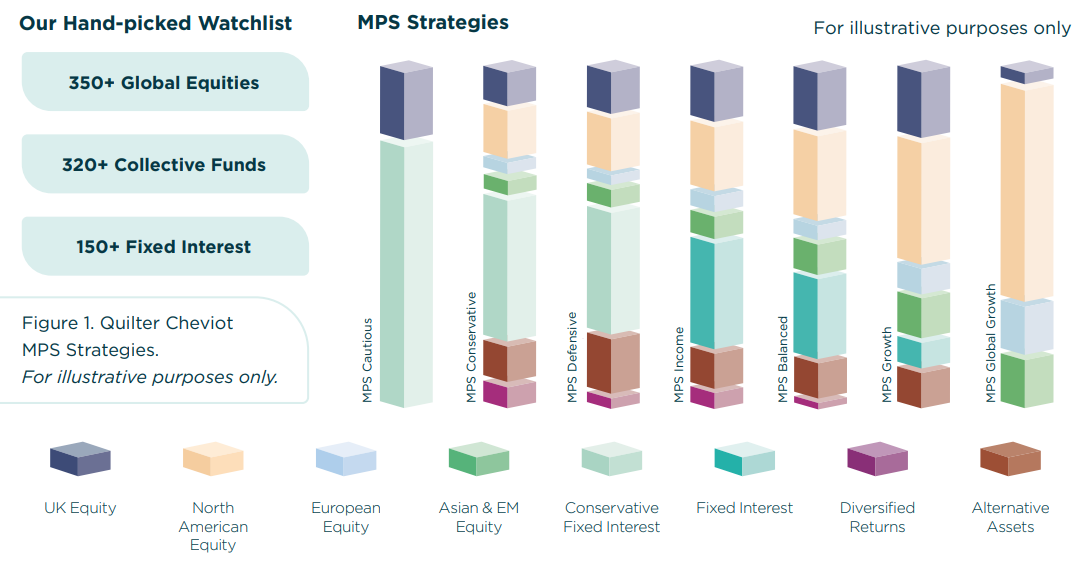
- The strategies are constructed solely using our ‘Building Blocks’ — eight purpose-built funds designed for use within Quilter Cheviot’s MPS. This allows a far greater degree of active management without burdensome costs, as we can select individual securities and fine tune holdings to our desired exposure.
- Quilter Cheviot is both the MPS model manager and underlying manager to the funds. This means changes to the holdings within each Building Block can be implemented at the fund level in a dynamic manner. Changes are immediately reflected across all holders, preventing the need for a portfolio rebalance and the accompanying operational complexity required by a ‘traditional’ MPS. Quilter Cheviot does not charge a management fee for the running of the Building Block funds, removing any conflict of interest - the funds are solely to enhance the investment proposition.
- The Building Blocks reflect our highest conviction investment views and they go beyond open-ended funds. They can invest in direct equities, direct bond holdings, exchange-traded commodities (ETCs), and closed-ended or exchange-traded funds (ETFs), irrespective of the wrapper in which your client’s portfolio is held.
Passive funds are only considered as a temporary home for flows or exposure to a specific index, instead of being relied on to lower costs. This avoids diluting active exposures and alpha-generating potential.
See Figure 1 below for an illustration of how the Building Block funds are used across our MPS strategies.
Service growth – whether adding new platforms, new strategies, strategic partners or bespoke portfolios – should not come at the cost of investment dynamism.
From previous experience, we know that implementing a rebalance across multiple platforms can be a laborious process, taking days, if not weeks, to plan and execute.
Many MPS providers schedule rebalances on a quarterly basis for operational efficiency, particularly if they run multiple “bespoke MPS” mandates. In recent years, we have experienced fast-moving markets, and this prescriptive, periodic approach can have a detrimental effect on performance.
Trade prioritisation is another issue with this approach as some MPS offerings may receive preferential treatment in executing trades, at the expense of others managed by the same provider. A firm may be rebalancing multiple bespoke or tailored MPS’, as well as their standard MPS – these must be put in order of priority by the MPS provider when scheduling that rebalance. Where do your clients sit in this order?
At Quilter Cheviot, we adjust our holdings at the fund level when required; typically on the same day as the decision is made to adjust the investments. This change is immediately reflected at the fund level across all shareholders and distribution channels. Full rebalances take place on an ad hoc basis to reflect our latest asset allocation views. This approach ensures that we do not need to compromise investment timing and positioning to account for operational bandwidth.
Our Building Blocks structure allows us to prioritise agility and precision in adjusting our market exposure, while remaining a model-based portfolio service. We dynamically reflect our “house view” in a responsive manner, capitalising on the research insights provided by our in-house equity, fund and fixed interest specialists.
The costs incurred by your clients and the performance they receive should be the same across all platforms.
Wherever you choose to access your MPS strategies, you should receive consistent exposures and management costs.
Fund and share-class availability can differ across platforms, meaning that proposition costs vary according to platform availability. MPS providers may be forced to make fund substitutions if boutique fund managers or certain share classes are not available on a particular platform, so you and your client may gain a different market exposure than expected.
The other option for MPS providers is that they prioritise consistency, with fund availability being the determining factor behind security selection, to the detriment of investment merit. This can impose significant restrictions on the resulting model exposures.
Our Building Blocks structure ensures consistency without any impact upon the investment preferences reflected across the strategies. We simply onboard our eight Building Block funds to each platform as the constituents of our models, resulting in the same holdings and share classes, irrespective of your chosen platform. And of course, within these funds, we are able to reflect the full investment universe of research recommendations that we wish to use.
An MPS should be a solution not a problem. Adjusting an MPS constructed using only third-party funds can lead to time out of the market for your clients.
Platforms typically operate on a “sales-then-buys” basis. Whilst this is standard practice, where an MPS provider relies on a rebalance to adjust the holdings in their strategies, this invariably equates to time out of the market.
When the instruction is made to sell holdings, the funds held may have different valuation points, trading profiles and cut off times. As a result, it can take several days before a sale price is confirmed. It is only after this that purchases can be placed, which can be 3-5 business days from the initial instruction.
While this may not appear a major concern, it can have an adverse impact on returns.
If 10% of the portfolio is rebalanced each quarter and this 10% is effectively out of the market for three days at a time, it results in a tenth of the portfolio being uninvested for 12 days a year — roughly 5% of trading days.
In addition to time out of the market, MPS providers may avoid certain funds due to their clunky trading profile i.e., those that require longer notice periods, have irregular valuation points or delayed pricing confirmation, thereby reducing the investable universe.
How do we avoid this? Our ‘Building Blocks’ structure simplifies the operational aspect of adjusting our holdings in three key ways:
- All changes to security selection are made at the underlying fund level as and when required without the need for a full rebalance, so there is no time out of the market.
- We only carry out a rebalance when we need to adjust the asset allocation.
- In this instance, the Building Block funds all have the same Authorised Corporate Director (ACD), trading and settlement profiles, keeping time out of the market to a minimum.
As an ancillary benefit, this means that portfolio turnover is significantly lower, which is beneficial from a capital gains tax perspective. In 2024, for a typical MPS Balanced client, portfolio turnover was on average 5%, down from 6% in 2023, 14% in 2022 and 26% between 2018-2020 prior to the move to the Building Blocks structure.
Client understanding of the services you are providing is key.
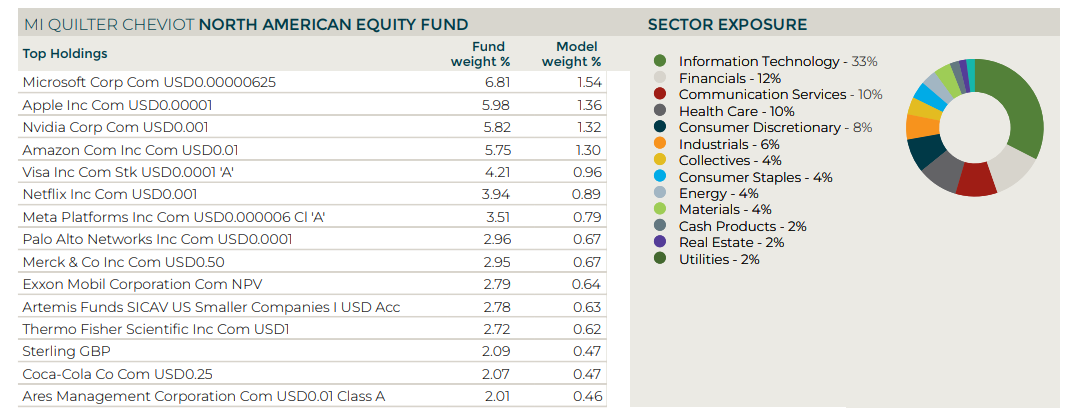
Each month, we provide detailed read-through reports (see example below) so that you and your clients can see the top holdings in each Building Block fund and what is driving the performance of their portfolio. The quality of the research recommendations that inform our MPS investment decisions is evident in both our reports and our monthly factsheets. This provides far more granular detail on holdings, rather than just showing exposure at the fund level.
Our approach allows us to gain diversification benefits, avoiding being too concentrated in one area and therefore reducing risk. The Building Blocks structure facilitates specific exposures and avoids conflicting messaging which can occur in less precise MPS strategies e.g. blending a ‘deep value’ fund alongside a ‘growth-orientated’ manager. This allows us greater freedom and accuracy so that we can invest in line with our house view, developed by the MPS managers and our in-house research team.
Holdings in the North American Equity Building Block fund (as at 31 May 2025).
Source: Quilter Cheviot Balanced Strategy factsheet
Our MPS strategies

We have partnered with the best providers so you can continue using your preferred provider with investments starting as low as £1,000.
Our exclusive platform partners
Our Managed Portfolio Service has been available on third party adviser platforms since 2011. As one of the first Investment Managers to offer service, the long standing relationships we’ve developed means you can benefit from extensive support throughout the process and we can respond to your needs quickly and efficiently.
Our partners have been carefully selected following feedback from advisers like you. To access your preferred platform, simply click on the links below:
| AJ Bell | Aviva | Benchmark |
| Fidelity | Fundment | M&G wealth |
| Morningstar | Nucleus | Quilter |
| Söderberg & Partners | Scottish Widows | Transact |
| Wealthtime |
If there are any platforms that you think we have missed and would like access to, please speak to our helpful team or your dedicated business development manager today.
For clients working with an adviser with £20,000 or more to invest, we are pleased to offer the option of investing directly through our nominee arrangements.
Your clients can access our market leading MPS strategies through own nominee arrangements. You will benefit from having access to a dedicated investment manager and detailed ‘x-ray’ reporting. Contact us today to find out how we can help you and your clients.
Find your local Business Development Manager
Your Business Development Manager is on hand to answer any questions you may have, as well as to support you throughout your relationship with Quilter Cheviot.

London and South East

David Butler
Head of Business Development - Advice
Helen Morrissey
Head of South - QC Sales
John Long
Head of Business Development - Professional Services
Mark Henderson
Business Development ManagerScotland and Northern Ireland

Hazel Willox
Business Development Manager
Kevin Kelly
Regional Development Manager
Marshall Docherty
Regional Development ManagerNorthern England and North Wales

Nick Lumb
Regional Development Manager
Paul Ruscoe
Head of North - QC Sales
Robin Gorse
Business Development ManagerSouthern England and South Wales

Dylan Jacobs
Regional Development Manager
Gareth Granger
Business Development ManagerMidlands

Greig Binnie
Regional Development Manager