
The page you were trying to view is not available for your role and region.
Over the past couple of years, the electric vehicle (EV) market has had no shortage of negative headlines. Subsidies were reduced in several regions, European sales temporarily plateaued, and investors began to question whether the transition had lost momentum. However, recent data indicates that the EV market has far from stalled; instead, it is evolving as adoption patterns, consumer preferences, and competitive dynamics continue to develop.
Momentum is returning
Global electric car sales exceeded 20 million in 2025, meaning that around one in four new cars sold worldwide was electric. The International Energy Agency expects this momentum to continue, with electric cars forecast to represent close to 30% of new car sales globally in 2026. This marks a clear re-acceleration after a period of weaker sentiment, and importantly, the drivers of adoption appear to be broadening.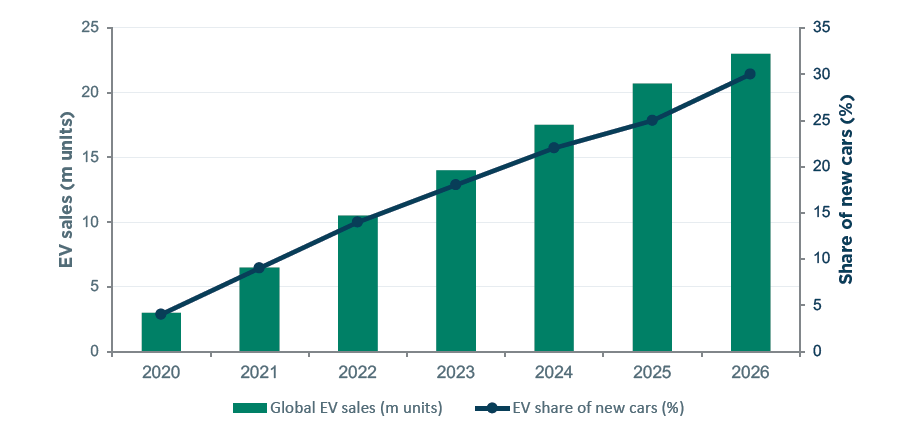
Source: International Energy Agency 2026
From subsidies to consumer economics
In the early stages of EV adoption, roughly from the mid-2010s to the early 2020s, subsidies, tax credits and other incentives played an important role in helping consumers overcome the higher upfront cost of electric vehicles. These measures supported the rapid growth of the market and helped manufacturers scale production.
As some of these incentives were reduced or removed during 2023 and 2024, parts of the market experienced a softer period for demand. This was visible in Europe and the US, where changing policy support and weaker consumer sentiment led some investors to question whether the transition had lost momentum.
Today, however, the EV market is becoming less reliant on subsidies alone. Higher petrol prices, partly linked to tensions in the Middle East and concerns around oil supply, have strengthened the financial case for EV ownership.
In the UK, petrol prices rose sharply earlier this year, with recent reporting noting that the cost of refuelling a typical 55-litre car was around £10 higher than before the Middle East conflict broke out at the end of February. This matters because the running-cost advantage of EVs can be significant. One UK comparison estimates that a typical petrol car doing 45mpg at 145p per litre costs around 14.7p per mile, while an EV charged at a standard home electricity rate costs around 7.1p per mile. On 10,000 miles a year, that equates to an estimated annual saving of roughly £760, with the saving materially higher for drivers able to use cheaper overnight EV tariffs.
This supports the case that EV demand is increasingly being driven by household economics and energy security, rather than policy support alone. When fuel becomes more expensive, the lower running cost of an EV becomes a more straightforward calculation for consumers.
At the same time, the upfront cost gap is narrowing. Battery technology continues to improve, charging speeds are getting faster, and a growing number of electric models are now priced competitively against petrol equivalents. This is particularly evident in China, where scale, manufacturing efficiency and battery innovation have helped drive down EV prices. The result is that EVs are moving closer to what UBS has described as “triple parity” with petrol vehicles: cost, range and charging convenience.
Policy still matters, but it is not the whole story
Policy support still remains relevant too, it’s just that the market dynamics are more complex than a simple reliance on government intervention. China continues to be the key engine of global EV growth, supported by strong industrial policy, incentives and extensive charging infrastructure. Europe remains broadly supportive, helped by emissions regulation and the need for manufacturers to meet tightening fleet targets, although policy has become more flexible in some areas. The US is a more challenging environment following changes to consumer incentives. However, used EV sales have continued to grow as prices have fallen, while EVs still account for around a quarter of vehicle sales in California. Looking ahead, more affordable models, including Ford’s planned electric pickup, could help broaden adoption further. These trends suggest that EV demand is increasingly being driven by economics rather than subsidies alone.
Where we see the investment opportunity
For investors, the key question is not simply whether EV penetration continues increasing, but where in the value chain it is most attractive to gain exposure. This is where our approach is deliberately selective.
Rather than trying to pick the winning car manufacturer or battery chemistry our Sustainable Opportunities strategies are positioned in the enabling technologies and infrastructure that support the wider transition. This matters because the EV market remains highly competitive. Carmakers face intense pricing pressure, especially from China, while battery cell manufacturing is capital intensive and often operates on slim margins. Raw materials exposure can also bring commodity cyclicality and sustainability challenges, including concerns around cobalt, water use and mining practices.
Instead, our exposure is focused on the “backbone” of the EV ecosystem: the companies that provide the semiconductors, power electronics, automation, testing equipment, grid infrastructure and clean power that is needed as the EV market expands.
For example, Schneider Electric is exposed to the electrification and grid infrastructure required to support higher EV adoption. As more vehicles are electrified, demand rises for charging infrastructure, grid upgrades, energy management systems and equipment that improves the efficiency and resilience of power networks. Schneider is therefore not dependent on which carmaker ultimately wins market share; it benefits from the broader need to invest in electrification infrastructure.
Similarly, Infineon plays an important role in power semiconductors, which are essential for managing electricity efficiently within EVs and across charging systems. These components help control power conversion, battery management and energy efficiency, all critical areas as vehicles become more electrified and as charging networks scale. NVIDIA also has exposure to technologies supporting vehicle electrification and intelligence, although this represents a smaller part of its business than it does for Infineon.
The strategies also invest in companies that support the development, production and validation of EV technologies. Rockwell Automation provides industrial automation and smart manufacturing software to help car companies build electric vehicles (EVs) and batteries faster and more efficiently. HORIBA provides end-to-end development and testing solutions for electric vehicles (EVs), covering battery systems, e-motors, fuel cells and complete vehicle validation. Intertek provides comprehensive global electric and hybrid vehicle testing services, focusing on battery and energy storage testing and certification solutions, as well as EVSE testing and certification, to help ensure safety, compliance and performance across the EV ecosystem. These holdings complement our exposure to electrification infrastructure and semiconductor technologies, while renewable energy holdings benefit from the growing requirement for clean power across transport and wider electricity demand.
This approach benefits from the growth of EVs without relying on a particular company emerging as the winner. Instead, we focus on businesses that provide the technology, equipment and infrastructure that support the wider industry.
Summary
We believe the recent shift in the EV narrative is highly encouraging. The investment case is increasingly being driven by economics rather than policy support alone. It is now underpinned by improving affordability, energy security concerns and the continued development of charging infrastructure. As sales of petrol and diesel vehicles continue their structural decline and EVs become more cost competitive, we believe the long term direction of travel remains clear, even if the pace of adoption varies across regions.
For our strategy, the opportunity is therefore not about chasing the most visible part of the EV market. It is about owning high-quality, cash-generative businesses that provide the essential tools, technology and infrastructure behind the transition. That approach has helped avoid some of the more volatile areas of the market, while still allowing participation in a theme that remains central to decarbonising transport.