The page you were trying to view is not available for your role and region.
Are modern data centres achievable?
Not a day goes by it seems without mention in the press of the billions of dollars being invested in modern data centres by the artificial intelligence (AI) hyperscalers — the likes of OpenAI, Alphabet, Oracle, Meta, Microsoft and Amazon. But what actually puts the modern into modern data centres and can they be built today or are they, for now, the dreams of tomorrow?
As well as on this page, you can listen to this podcast on:


Powering the AI boom
The scale of large language model (LLM) development, the brains behind AI, is driving demand for data centre capacity with model size growing to 1tn parameters from 100bn three years ago. This has fuelled a jump in the number of answers AI can churn out to a single question (inference) to 100 from one which, along with the growth in the number of people using AI, makes it easy to see why more computing power and hence more data centres are needed.
ChatGPT has grown to 800m users from 100m at the end of its first year. A similar rate of growth from enterprise is expected over the next five years.
The problem is that data centres are power and infrastructure intensive. Today’s facilities hold more AI chips in racks than earlier versions. Power density per rack is therefore higher. The GPUs (the Graphics Processing Units) themselves use more energy too. Even though next-generation GPUs are more power efficient with Nvidia chips typically delivering a roughly 130% improvement every year with only an extra 30% of power, there is no escaping the fact that demand for power is rising.
Historically, data centres were built with 10MW capacities. Increasingly, 100MW or even 1GW campuses are being developed. Data centre power demand, in aggregate, from the US and Asia could grow by over 20% per annum between 2023 and 2030, while Europe could be somewhere in the mid-teens. In the US, this anticipated growth is expected to triple AI’s share of total electricity demand to 9% by 2030.
A standard Google search demands around 0.3 watt hours of energy whereas a Chat GPT query uses 10x that amount.
Breaking the bottlenecks
Meeting the expected surge in power demand will be a challenge, one made more difficult in the US by the current administration’s opposition to renewable energy. This has created bottlenecks elsewhere. The lead time for small gas turbine power-generating equipment now stands at three years and for large turbines, it is closer to four-five years.
Once a power source is in place, the next challenge is to secure access to the grid. Requests in many regions far exceed capacity with wait times for new facilities to be connected to the grid stretching out to five or even 15 years in some areas of the US and Europe.
To get round these bottlenecks, hyperscalers are being strategic and innovative. US data centres are being built in areas where there is an excess of power. Developers are also embracing the concept of BYOP (bring your own power). Having a power source on site (gas turbine, solar or wind power) removes the need for grid access. Gas turbines offer the quickest route to electricity for data centres. Nuclear options, in the form of small modular reactors (SMRs), are a longer-term solution but, as the technology is still being tested, the timeline here is estimated at around 10 years.
The very model of a modern AI-data centre
Gaining access to power and the grid is just a first step. Modern data centres must also deliver the step-up in computing power required to carry out the complex calculations being demanded of them. The computing power of new, 1GW data centres is set to increase to 5,000 exaflops — the biggest supercomputer in the US currently runs on one exaflop.
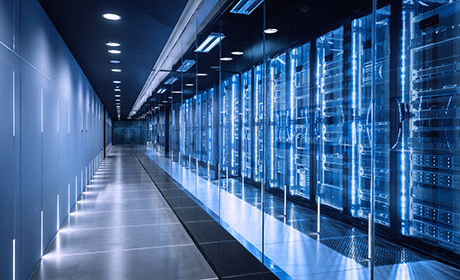
The exaflop is a measure of computing power: one exaflop is a computer doing in one second what it would take a human one billion years to do.
To accommodate this giant leap in computing power, the entire architecture of data centres requires a rethink. More direct current (DC) equipment, for example, will have to be installed as opposed to the predominantly alternative current (AC) infrastructure currently utilised. So, technical changes, including in transformer switch gear, power supplies, power distribution, are the hallmarks of a modern data centre.
As is energy efficiency. Data centres live or die by their efficiency metrics. A key one is PUE (power usage effectiveness) which looks at how efficiently a data centre uses electricity.
A PUE of 1.0 is perfect with all electricity going into computing. Top operators average 1.1PUE – so already not too far from a perfect score.
Other metrics include:
- water usage effectiveness (WUE), particularly relevant if the cooling system used is liquid as opposed to air-based
- Scope one, two and three carbon emissions; and
- the percentage of renewables used to power the facilities.
From a sustainability perspective, the ideal facility would be directly powered by renewable energy, potentially co-located with a wind or solar farm. It would be designed to be energy efficient with a PUE as close to one as possible. The data centre would use a direct-to-chip cooling system and be water efficient. It would be constructed using low carbon cement and steel. Waste heat would be reused in other parts of the facility or the community. And finally, real-time data on energy efficiency, emissions profile and waste heat usage would be available.
And here’s the thing, much of the ideal scenario above is being implemented today. Just as well too. For if the promise of AI is to be realised, nothing but the very model of a modern AI-data centre will likely do.
Approver Quilter Cheviot: 02/01/2026
This is a marketing communication. Investors should remember that the value of investments, and the income from them, can go down as well as up and that past performance is no guarantee of future return. You may not get back what you invest.