
The page you were trying to view is not available for your role and region.
We identify six key questions for 2026:
- Can equity markets continue to move higher?
- Will US events dominate markets again this year?
- Is the AI rally going to continue? / Is tech in a bubble?
- What is the European outlook?
- Are central banks finished with rate cuts?
- What does diversification mean today?
However, before looking ahead to this year, it’s worthwhile setting the scene for where we currently are, from an investing perspective, with a brief review of 2025.
- 2025 was another strong year for equities, with the MSCI All Country World Index returning 14.4% in sterling terms (all data from LSEG Datastream unless specified otherwise). The gains came despite a number of negative news headlines including trade tariffs, the longest US government shutdown on record, heightened geopolitical tensions in the Middle East and the ongoing Russia/Ukraine war.
- After two years of US exceptionalism, it was the UK (25.8%) and Europe (27.2%) that stood out last year, with Emerging Markets (25.1%) not far behind. The gains in Europe were driven by the announcement of large-scale German fiscal stimulus and countries in the bloc ramping up defence spending to meet their NATO commitments. This has yet to come through to the bottom line with European earnings falling 1.1% on the year, due to some drag from the weakening dollar. However, 2026 consensus expects to see a 13% rise in European earnings.
- 2025 saw the best relative performance for international stocks versus the US since 1993, with MSCI All Country World Index excluding the US outperforming MSCI North America by 13.5% in sterling terms. MSCI North America returned 10.4% but 17.7% in local US dollar currency terms marking only the third time on record the market has posted three consecutive 15%+ annual returns (1997-1999 and 2019-21). Strong corporate earnings supported US stocks despite threats from higher trade tariffs, and concerns about tech valuations, with earnings per share rising 12%.
- Currency moves played a larger than usual role in 2025, with sterling rising 7.7% against the US dollar. Gold had a very strong year, rising 64.6%. Heightened geopolitical tensions and the expectation of more aggressive Federal Reserve (Fed) rate cuts supported the gold price, but over time it was clear there was increased retail speculation and elevated volatility. The relationship between gold and interest rates had broken down and it was not clear whether that was temporary or not. Meanwhile the current price is in the region of 2x-3x the cost of production, which is a large historical disconnect. Since 1990, gold posted an annual return of 7.5% with 16.1% volatility, which is lower return and higher volatility than global equities, so 2025 was a truly exceptional year for gold.
- Treasuries and gilts had their best return in five years despite all the worries about budgets and government debt. Short-dated gilts made their best returns since 2008 so good news for lower-risk investors. Gilts on average returned 0%. The best gilt returns came in the 5-15yr (5.9%) part of the curve, with the short end also outperforming (0-5yr: 5.1%) while the longer end (gilts 15yr+: 3.7%) lagged due to higher UK inflation and a global rise in long-dated yields due to debt sustainability concerns. Index-linked bonds returned 1.4%. UK investment grade corporates 7.3%.
After very volatile but very strong financial market returns in 2025, looking forward we anticipate continued positive returns in risk assets, although more moderate than last year. The six key questions we see for 2026 include:
In a word, yes. The strong run higher in recent years may have left some investors feeling nervous but history shows that new all-time highs are often a better time to invest than average. Highs beget new highs.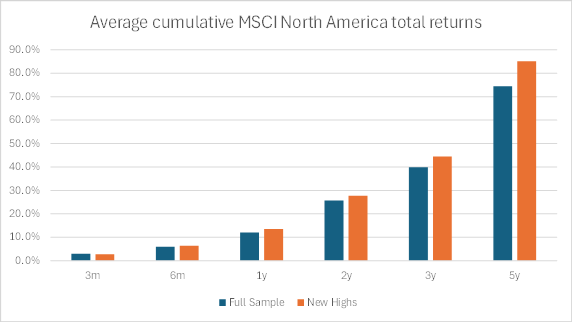
Source: LSEG DataStream, Quilter Cheviot Limited 18/12/2025
Past performance is not a reliable indicator of future results. The value of investments and the income from them can go down as well as up.
For instance, the MSCI North America has posted an average cumulative return of 85.1% five years after making a new high, compared to 74.5% on average (data going back to 1988). This shows that investors taking money off the table after a good run can lead to worse outcomes and once more that time in the market beats timing the market.
The key thing is to follow the fundamentals. It is more important to look at valuations, rather than the price level. Global equity valuations are not that elevated with the MSCI All Country World Index 12-month forward price earnings (P/E) ratio at 19.2x (as of 5 January 2026). While this is one standard deviation above the average since 1988 it is not too worrisome given the decent global growth outlook, and the fact that most equity regions are trading at or below their long-run averages. The global equity valuation is being pushed higher by the US market, with the MSCI North America trading on a valuation of 22.3x. Here there is an argument to be made the higher valuations over time are justified due to improving profit margins. In the US the average profit margin by decade is as follows:
1990s: 6.3%
2000s: 7.1%
2010: 8.7%
2020: 10.1%
Rising profit margins suggest higher multiples are justified. While it is only a snapshot, last year, US stocks posted 14% earnings growth against a challenging backdrop, further supporting this point. While US big tech has supported a fair portion of the earnings growth in recent years there is evidence that there has been a broadening out across countries and sectors, which we anticipate will continue. The consensus global EPS forecast continues to improve, with 2026 MSCI All Country World forecast to grow 14.7%, backed by an estimate for global GDP growth of 2.9%, some moderate inflation and some company specific operational leverage combined with operational or strategic enhancements. Whilst there could be some downside revisions to the consensus growth outlook, we would still anticipate double-digit earnings growth given the global macroeconomic outlook.
There is little doubting that the US was front and centre of investors’ minds in 2025, with Liberation Day tariffs, the Big Beautiful Bill, talk of an artificial intelligence (AI) bubble and the longest US government shutdown on record. This will likely continue in 2026, which should not be too surprising given that the US is the world’s largest economy and accounts for 64.1% of the MSCI All Country World Index.
One of the biggest known unknowns for financial markets is the question of who will replace Jay Powell as Federal Reserve chair. Powell’s eight-year term is due to end in May 2026 and there is a feeling that his successor may not be as impervious to pressure from Donald Trump to lower interest rates. The Wall Street consensus is currently that White House adviser Kevin Hassett will get the job which, should it occur, would raise questions over Fed independence going forward.
While the US stock market dominates global equities, the US Treasury market plays an arguably more important role in global finance. Should Fed independence be diminished and market participants start to believe that the Fed is running a political agenda then bond vigilantes could target US Treasuries and if there’s a fallout in that market, the repercussions will be felt far and wide. This also plays into the US dollar which, as the world’s reserve currency, has the potential for far reaching impacts should it undergo a sizeable move. However, as was seen in 2025, the most likely impact would be a steepening of the yield curve, with safe-haven shorter-term bonds gaining in value, and longer-term bonds losing value on concerns around the potential for higher long-term inflation. Meanwhile the recent weakening in US macro data, and labour market data, from high levels, suggests markets are increasing their expectations for rates cuts anyway.
2026 is also a mid-term year so politics will no doubt play a key role. Should the Republicans lose control of one, or both, houses of Congress then their ability to enact change will be greatly reduced.
There are also unknown unknowns to be on the lookout for. In the first few days of 2026, Venezuelan President Nicolas Maduro was ousted and brought for trial in New York. The Trump administration has been consistently unpredictable, and the biggest surprise of 2026 would be if there were no surprises on that front at all.
AI and big tech have been the talk of the town for a number of years now and they will no doubt continue to play a key role for financial markets going forward. The last six months have seen tech-bubble calls grow. We believe that while there are a number of warning signs that the current dynamic is not sustainable, the rally has been built on fairly firm foundations and investor sentiment appears to be nowhere near the heady heights of the dotcom boom around 2000.
Given the press headlines you may be surprised to learn that the UK, European and Emerging Market benchmarks all outperformed the 23% return from Mag Seven stocks (Alphabet, Amazon, Apple, Meta, Microsoft, Nvidia and Tesla) last year. In fact, only two of the seven, Alphabet and Nvidia, outperformed the broader US market. Alphabet was something of a turnaround story as a favourable Department of Justice court ruling and the latest release of Gemini changed the perception of it being an AI loser due to falling search traffic into a firm that could strongly benefit from AI adoption, while Nvidia continued to post staggering earnings growth above analysts' expectations.
If we exclude Tesla due to it being an automaker, then the Magnificent Six trade on a price/earnings ratio of around 26.5x versus 22.3x for the MSCI North America index and 19.2x for the MSCI All Country World index. There is some justification for this premium based on earnings growth. US technology stocks grew their earnings by 30% in 2024, compared to 5.2% for the rest of the US market. In 2025 earnings growth is expected to be 23.4% for technology stocks versus 6.1% for the rest of the market, according to FactSet. This differential is forecast to narrow further in 2026, with technology stocks seen as growing earnings by 23.8% and earnings for the rest of the market growing 10%.
26.5x P/E is also substantially lower than previous bubbles. During the dotcom peak in 1999 the market reached a P/E of 60x. The Nifty Fifty in the 1970s reached 45x and Japan hit 72x in the late 1980s.
While we believe AI is a potentially transformative technology with considerable growth potential ahead, from an investment perspective the risks are more evenly balanced than a couple years ago. The current environment is best approached with a high degree of selectivity, and we will focus on growth at a reasonable price, not any price. Caution should be heeded in some areas, particularly around vendor financing and rising capital expenditure to sales. Should we start to see a slowdown in corporate IT spending, digital advertising or capex, then the market may start to get jittery. Having said that, for now we believe it’s time to hold your nerve and stay level-headed. The market has been raising some flags, and it is prudent to be a little more cautious at this time, but we are not yet in bubble territory on the quality, profitable names.
The start of 2025 was especially strong for Europe, with a major structural shift in the bloc demonstrated by the release of the German debt brake (constitutional limit on government deficit spending). This larger fiscal deficit tolerance is a welcome boost and should increase growth going forward. The lessening reliance on US for security had led to a step-change in European defence spending and even if a Ukraine ceasefire is reached, we believe the theme will still have some time to run. While the Russian invasion of Ukraine was the catalyst, the broader theme is one of a move away from relying on international organisations like NATO for defence and looking more at taking control at a national level.
European inflation is tracking below peers, with the European Central Bank (ECB) forecasting 1.9% in 2026 and 1.8% in 2027. The benign inflationary backdrop has allowed a number of interest rate cuts in recent years, with the ECB lowering its key deposit rate to 2.0% from 4.0% in April 2024. The last cut came in June 2025 and due to lags in the transmission mechanism will likely still be feeding its way through to supporting the economy. Furthermore, a deposit rate of 2.0% is less restrictive than peers and therefore should support economic activity. Leading economic indicators are pointing to increasing growth and earnings momentum and forecasts are being revised higher in Europe. The large-scale spending plans have not yet fed through to higher company earnings, with earnings growth actually negative for European stocks in 2025 (-1.1%), in part due to currency impacts. However, the outlook is far more favourable with the recent improvements in earnings forecasts, leading to consensus now calling for 12.9% earnings growth in 2026 and we see a fairly long runway ahead for the fiscal stimulus to provide additional growth.
Even after a strong 2025, market valuations remain attractive in our view, with the Eurozone trading on a 15.2x 12-month forward price/earnings ratio. We see higher growth potential in the Eurozone than the UK and this should also support financial markets.
The second half of 2025 was not quite as strong for European stocks, partly due to concerns surrounding the impact of US trade tariffs. At the December European Central Bank (ECB) meeting president Christine Lagarde declared that the impact of tariffs had not been as bad as previously thought, leading to upwards revisions to growth forecasts and downward revisions to inflation forecasts.
No, the Fed and Bank of England (BoE) are both expected to lower base rates by around 50 basis points (0.5%) in 2026. The latest inflation figures from both were significantly lower than expected (US Consumer Price Index (CPI) 2.7% and UK CPI 3.2% year on year) and while we should be wary of reading too much into one print, it is fairly safe to say the worry that a second wave of high inflation due to trade tariffs appears overdone. Energy prices can play an important role in inflation dynamics and last year the oil price fell 19.4% despite geopolitical tension in the Middle East and Russian embargoes.
The key thing to watch in the US is the next Fed chair and whether they follow a markedly different approach to Jay Powell. Donald Trump is an outspoken fan of lower interest rates, regularly applying pressure on the Fed to lower them. There is a fair amount of room for rate cuts with the Fed Funds rate at 3.50%-3.75%.
In the UK, fiscal policy of increased government spending, higher living wages and above-inflation public sector pay rises have increased price pressures. Having said that, going forward this will have less of an impact, with the government seemingly front-loading many of their measures.
The ECB is not expected to lower rates further in 2026, but the deposit rate is already at 2.0% - down from a high of 4.0% since April 2024 - and with inflation tracking lower than in the UK and US, there is potential for further easing should the situation require it.
It is a cliché but diversification remains the only free lunch in investing. The strong performance of UK, European and Emerging Market equities in 2025 demonstrated the value of this approach. There seems to be a growing shift towards nationalism, with countries more inward looking in their approach and this may lead to greater variance among different stock markets over time. We see Europe and Emerging Markets as two of the more attractive investments in 2026.
While geographic diversification is important, greater diversification can usually be found across asset classes. Gilts returned 5% in 2025, a solid return with far less volatility than equities. In the event of growth shocks, we would expect bonds to outperform equities, but there have also been more inflationary shocks in recent years, and bonds perform less well in that environment. As we saw in 2022, higher inflation leading to higher interest rates is a poor backdrop for both bonds and equities, with hedge funds one of the best performers in that sort of environment.
We also see potential in the private equity (PE) space, where investments are typically less accessible to most investors. Traditionally PE investments have been more for institutional investors and pension funds, and they have historically offered higher rates of return. Quilter Cheviot is the first discretionary fund manager to offer PE investing through evergreen structures. This means the PE investment has an indefinite lifespan, with the PE fund continuously raising and reinvesting capital, as opposed to a traditional closed-end fund with a fixed term, or private equity investment trusts which are also closed ended vehicles but listed on exchanges.
Some of the advantages of private equity investment include having greater influence over management and strategic decisions but comes at the expense of needing to invest for the long run.
Conclusion
As we move into 2026, the investment landscape remains promising but nuanced. While equity markets appear poised for further gains, supported by solid fundamentals and earnings growth, investors must navigate uncertainties around US policy shifts, central bank actions, and geopolitical developments. The AI-driven tech sector continues to offer opportunities, albeit with a need for selectivity, and Europe stands out with improving growth prospects and attractive valuations, as do Emerging Markets. Diversification across geographies and asset classes remains essential, particularly given evolving macroeconomic dynamics and structural changes. We see an interesting evolving opportunity set with increased diversification in the private equity space versus the listed equity space.
Overall, a disciplined, balanced approach will be key to capturing opportunities while managing risks in the year ahead.
Approver: Quilter Cheviot, 12 January 2026
Important Information: This document is a marketing communication. It is not independent investment research and should not be considered investment advice or a recommendation to buy or sell any security. Past performance is not a reliable indicator of future results. The value of investments can go down as well as up, and you may not get back the amount invested.
Would you like to speak to one of our experts?
You can contact us by phone, email or simply complete the online form and our team will be in touch with you soon.