
The page you were trying to view is not available for your role and region.
Short-term bond strategy
At Quilter Cheviot we have launched a model within our short-term fixed income strategy that invests based on the different tax treatment of gilts. The model is especially attractive for higher rate or additional rate taxpayers. It is based on a number of short-term, low coupon gilts that mature within the next few years. On current prices this is an opportunity for investors to lock in an attractive yield, net of tax, if they hold the bonds until maturity.

A tax-efficient discretionary strategy investing in carefully selected individual gilts with short-term maturities.
To provide higher-than-cash returns for clients with a low-risk profile. The discretionary strategy is tailored for tax efficiency and therefore is relatively more attractive for higher or additional rate taxpayers.
A gilt is a UK government bond. These are issued with a fixed interest rate and used by the government to help finance public spending. They are considered a comparatively low-risk investment.
There is a broad spectrum of gilt maturities, spanning up to 50 years. Short-dated means that they mature within the next five years. For this strategy we only invest in gilts at the short end of this spectrum, meaning there is a relatively short amount of time until the government is due to repay the face value of the bond.
The Treasury 0.125% 01/2028 Gilt is an example of a short-dated gilt, carrying a 0.125% coupon and maturing in January 2028.
There are two ways that an investor can benefit from an investment in gilts:
- price appreciation, and
- coupon income payments.
Taken together, this is referred to as the yield to maturity. As gilts are not subject to capital gains tax, tax is only levied on the coupon payment.
The tax treatment of coupon income from gilts can have a substantial impact on net returns for investors – particularly those in the higher rate or additional rate income tax bands. This means that the after-tax returns from a low coupon bond are significantly higher than those from a bond with a similar yield to maturity but a higher coupon.
| Bond | A | B |
| Maturity | Jan-28 | Mar-28 |
| Coupon | 0.125% | 4.375% |
| Price | 93.63 | 101.367 |
| Gross Yield to maturity | 3.41% | 3.70% |
| Net of 20% income tax | 3.38% | 2.83% |
| Net of 40% income tax | 3.36% | 1.96% |
| Net of 45% income tax | 3.35% | 1.74% |
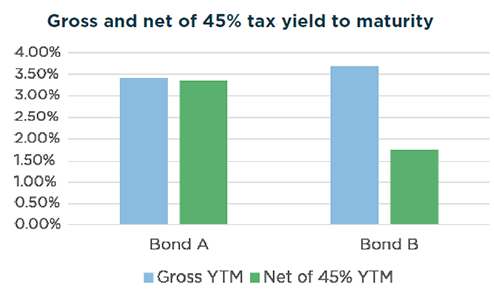
Although the higher yield environment has also raised the interest offered by banks, the tax treatment is less favourable as it is levied at the investor’s income tax level on the total return. This is best demonstrated with the following hypothetical examples.
| Bond | Price | Coupon | Maturity | NRY 45% | Bank AER* |
| A | 93.63 | 0.125% | 31-Jan-28 | 3.35% | 6.09% |
| B | 90.99 | 0.50% | 31-Jan-29 | 3.44% | 6.25% |
| C | 90.13 | 0.875% | 22-Oct-29 | 3.30% | 6.00% |
*AER = Annual Equivalent Rate, assuming additional rate (45%) income taxpayer
For instance, security B offers a 3.4% net redemption yield, meaning an investor receives a total, after-tax, return of 3.4% per year until maturity, at the end of January 2029. As the investor is in the additional rate taxpayer bracket, they pay 45% tax on interest income. This means they would need to earn 6.3% in interest from a bank to end up with the same total, after-tax return.
- Movements in interest rates will not impact returns from gilts, as long as they are held until maturity. At maturity the proceeds will typically be reinvested at the next most attractive net redemption yield, however some clients with a particular requirement can be paid out. There is the risk that bank interest is revised periodically, which means that if interest rates fall in the coming years
banks will offer lower levels of interest to savers. - The tax efficient part of the investment strategy is time sensitive and will likely become less attractive as time goes on. This is because low coupon gilts are typically issued in periods of low interest rates, as we’ve experienced in previous years. Future gilt issuance is expected to carry coupons more aligned to the overall yield to maturity and therefore even if a gilt is issued with a yield of 5%, that will likely be with a coupon of, or very near to, 5%.
The current situation has arisen because gilts in previous years were offered when yields were close to zero and therefore the coupon – the part of return subject to income tax – was close to zero EG 0.125%. As interest rates have moved sharply higher the price of these gilts has fallen so that the total yield has increased accordingly. - Recent developments and heightened uncertainty have increased the attraction of less risky assets for investors. However, another aspect of this is that it’s uncertain how long this uncertain period will last. Should the investment environment improve markedly, then investors may wish to move out of less risky assets and into areas such as equities. As the short-term bond strategy is a discretionary portfolio service, this can be easily achieved should circumstances change. There is a greater degree of flexibility and clients will not be locked into investments.
The UK government has always repaid domestically issued debt, so gilts are considered one of the most secure places to keep your capital. There have been a number of bank failures in the last 15 years and while the Financial Services Compensation Scheme protects losses, this protection is capped at £120,000. Any losses in excess of £120,000 are therefore not covered.
Upon maturity of the gilt, clients can either reinvest into the short-term bond strategy, move to another discretionary strategy or withdraw their money.
The standard management fee for this service will be 0.25% per annum up to £2,000,000 invested. Amounts above £2,000,000 will face a tiered fee structure, the first £2,000,000 at 0.25% and amounts in excess of this at 0.20%. The minimum investment amount is £250,000.
* Gross yield to maturity calculations are annual and accurate as of 21 January 2026. Forecasts and past performance are not a reliable indicator of future performance.