The page you were trying to view is not available for your role and region.
Artificial intelligence (AI) has quickly become one of the defining investment themes of this decade. While much of the attention focuses on the software and applications powered by AI, we believe some of the most compelling investment opportunities lie in the physical infrastructure that makes AI possible.
Approximately 15-20% of the Sustainable Opportunities strategy was directly exposed to the data-centre supply chain. This reflects our conviction that AI is driving a multi-year investment cycle across the infrastructure ecosystem that underpins the digital economy.
A Build-Out on an Unprecedented Scale
The growth in AI is creating extraordinary demand for computing power, data storage and connectivity. Meeting this demand requires significant expansion of data-centre capacity around the world.
US data-centre capacity is expected to double from 2024 levels by the end of 2027 and more than triple by 2030, reaching approximately 125GW, according to Goldman Sachs. McKinsey forecasts that global installed data-centre capacity could reach around 220GW by 2030, representing a sixfold increase from 2020 levels.
The scale of capital being committed to support this growth is equally striking. In August 2026, a consortium including Apollo, Blackstone, BlackRock, Brookfield, Goldman Sachs and KKR signed memorandums of understanding with Nvidia to mobilise more than $500bn of third-party capital for AI infrastructure over time.
Importantly, industry participants continue to stress that demand is growing faster than supply. “Every unit of supply you bring online actually feeds a multiple of that in additional demand, rather than solving the existing demand,” said Daniel Robert, co-chief executive of Nvidia partner Iren. He went on to note that it is “really hard to see how the supply curve ever overtakes the demand side.”
Capturing Opportunity Across the Value Chain
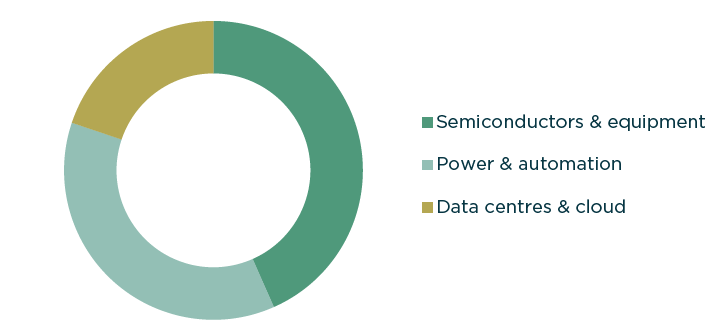
Rather than relying on a single company or technology, our exposure spans multiple stages of the data-centre supply chain.
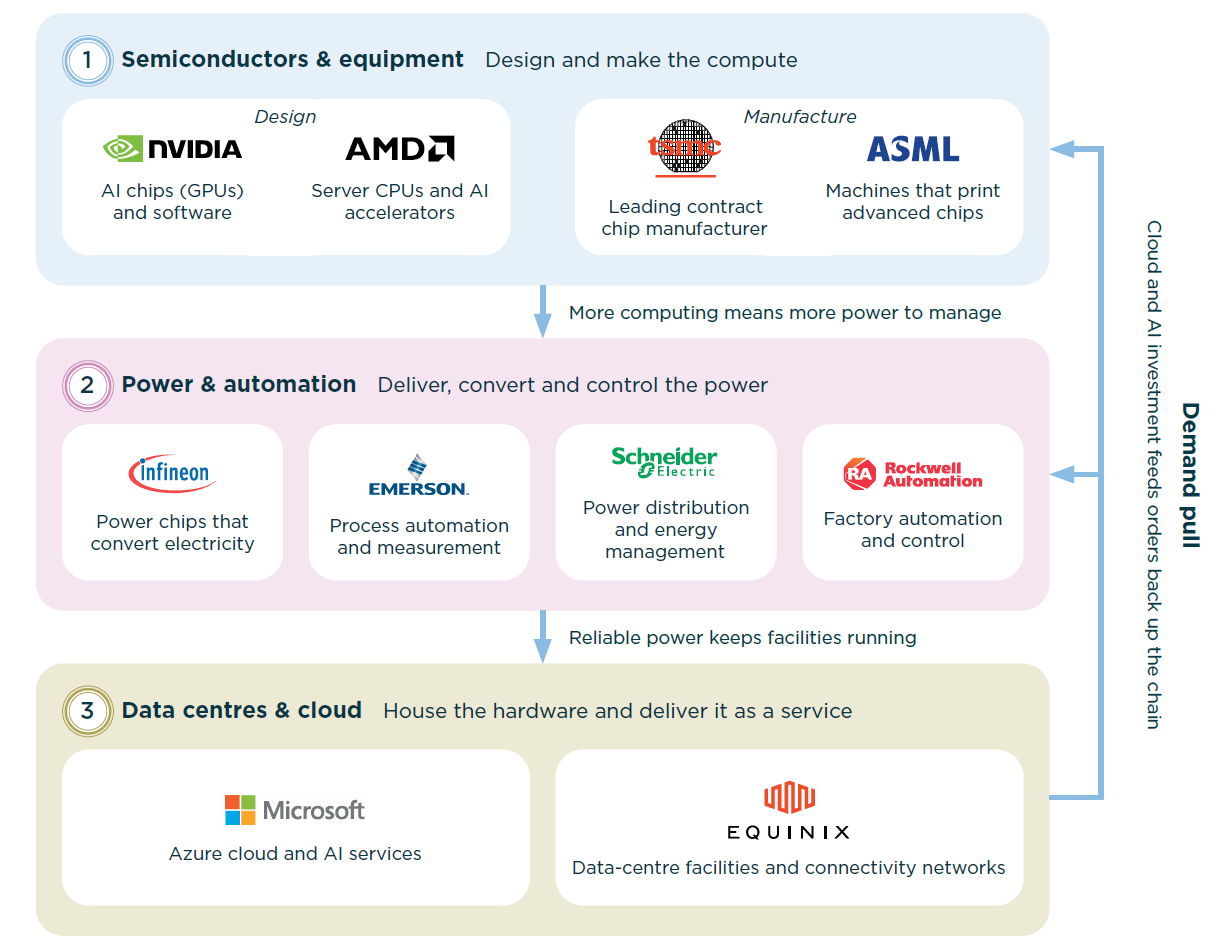
The largest allocation is to semiconductors and equipment, representing 5-10% of the Sustainable Opportunities strategy. These companies design advanced processors, manufacture chips and provide the highly specialised equipment required to produce them. For example, we like Nvidia because it combines a leading position in AI processors with a high-quality software ecosystem. Its graphics processing units provide the computing power behind data-centre AI workloads, while its broader platform helps customers deploy and scale increasingly complex models. This combination of specialist hardware and software makes Nvidia a key beneficiary of continued investment in AI infrastructure.
A further 5-10% is invested in power and automation businesses. As data centres become larger and more computationally intensive, managing electricity efficiently becomes increasingly important. Schneider Electric supplies critical power-distribution, energy-management and cooling technologies used to keep data centres operating reliably. We like its broad exposure to electrification and digitalisation, as well as the increasingly important role its systems play in managing higher-density AI facilities. Emerson Electric complements this exposure through automation, measurement and control technologies that help operators monitor equipment, improve efficiency and reduce downtime. Rockwell Automation supports factory and equipment automation, while Infineon produces power semiconductors that improve the conversion and control of electricity.
The strategy provides c.5% exposure to physical data centres and cloud infrastructure. Equinix operates many of the facilities and connectivity networks that house critical digital systems, while Microsoft continues to expand its cloud footprint through Azure. Microsoft’s Azure cloud business grew 40% year-on-year as of the first quarter of 2026, supported by strong AI-related demand, and the company has announced approximately $175bn of data-centre investment during 2026 alone. Microsoft accounted for approximately 20% of the global cloud-infrastructure services market in the second quarter of 2026, making it the second-largest provider behind Amazon Web Services.
Microsoft’s investment case has been supported by increasing evidence that AI is strengthening, rather than merely consuming cash from, the existing cloud and software franchise. Revenue rose significantly from Cloud and Azure passed $100bn of annual revenue, and Microsoft 365 Copilot exceeded 30m paid seats. Microsoft is now monetising AI at several levels: infrastructure through Azure, models and developer services, and applications through Copilot.
Why This Matters for Investors
One of the most attractive aspects of the theme is that investors do not need to predict which AI application, chatbot or software platform ultimately succeeds. Anthropic chief executive Dario Amodei in his “We Must Pace the Frontier”
essay called for training to move from “very fast to fast” rather than advocating a halt to AI development.
It is an argument that AI progress is becoming so powerful that safety research, testing and governance may become the next critical bottleneck, alongside compute. If frontier training is paced, does industry spending shift from capability creation toward safety, testing, evaluation and interpretability infrastructure?
Amodei argued that frontier development should be paced rather than halted, allowing safety research, testing and governance to keep up with advances in capability. If this approach becomes more widely adopted or regulated, some spending could shift towards evaluation, interpretability, security and other safety infrastructure. This would add another layer of investment alongside the physical compute required to train and run AI systems.
Regardless of which companies emerge as long-term winners, the underlying infrastructure requirements – in many cases - remain broadly the same. AI systems need advanced processors, networking equipment, electricity, cooling systems, monitoring technologies and data-centre capacity. As demand for cloud computing, data processing and AI services grows, investment across this physical infrastructure stack is likely to continue.
This creates opportunities for many of the businesses we already own. The products and services they provide are often mission-critical, enabling the digital infrastructure on which AI applications depend. Whether one platform or
another ultimately dominates the AI landscape, the need for reliable computing power and supporting infrastructure is unlikely to diminish.
Technology as Part of the Sustainability Solution
Beyond the direct investment opportunity, we also view technology as an important contributor to sustainability outcomes.
While AI’s energy and water requirements have attracted considerable criticism, the technology also has the potential to improve efficiency across each of our five investment themes. In Clean Energy, AI can help forecast renewable generation and balance electricity grids. Within Food, precision agriculture can optimise irrigation, fertiliser use and crop yields. In Health & Well-Being, AI can support medical imaging, diagnostics and drug discovery. For Resource Efficiency, it can improve industrial automation, transport networks, building energy management and waste systems. In Water, AI-enabled monitoring and leak detection can help utilities identify losses, manage networks and improve treatment processes.
AI-enabled technologies could reduce global greenhouse-gas emissions by up to 5.4bn tonnes annually by 2035, driven by improvements across sectors such as power generation, transportation and food systems, according to research from the Grantham Institute
For sustainable investors, this presents an important long-term opportunity. The same technologies driving increased demand for data-centre infrastructure may also help address some of the world’s most significant environmental challenges.
Looking Ahead
The rapid growth of AI is creating demand not just for software, but for the physical infrastructure that enables it. We believe this build-out is likely to remain a powerful investment theme for years to come.
By investing across the data-centre supply chain, from chip designers, semiconductor manufacturers and equipment providers to power-management specialists and infrastructure operators, we aim to capture opportunities created by the expansion of the digital economy while maintaining a diversified approach. At the same time, we continue to see technology as a potential enabler of a more efficient and sustainable future.
For investors, the opportunity may not lie in predicting the next winning AI application, but in owning the businesses that make the entire ecosystem possible.
Author

Claudia Quiroz
Head of Sustainable InvestmentMonthly newsletter
Don’t miss the Sustainable Opportunities Funds monthly update – delivered straight to your inbox.
Sustainable Opportunities Funds
The Sustainable Opportunities Funds invests in companies that make a positive contribution to the world, with a strong underpinning of ethical values.