
The page you were trying to view is not available for your role and region.
Andy Burnham has moved quickly since becoming UK Prime Minister, announcing an £850m plan to cut domestic energy bills this winter on his first full day in office. Tackling the cost-of-living crisis has been central to his agenda, and further fiscal changes are widely expected.
Burnham is the UK’s fifth prime minister in four years, and the seventh since the 2016 Brexit referendum. Given the state of the economy and political backdrop, any honeymoon period is likely to be short. His first 100 days are expected to be important in setting out the government’s agenda and improving Labour’s weak polling position.
While we are aware of the inevitable pitfalls associated with attempting to precisely predict outright future events, we believe there can be real value to be had in conducting scenario analyses of possible outcomes. We are not attempting to predict events precisely or position portfolios ahead of specific outcomes. Instead, scenario analysis helps us prepare for a range of possible policy paths, identify risks and opportunities, and respond in an informed way if they emerge. Major fiscal clarity is unlikely before the Autumn Statement, expected in November, but Burnham’s speeches suggest higher government spending. Whether this is funded through tax rises, additional borrowing, or both remains unclear.
Burnham has reiterated Labour’s two fiscal rules: day-to-day spending should be funded by tax revenues, with borrowing only for investment; and public debt as a share of GDP should be falling by the end of the term. Without changing these rules, his options are limited. Spending cuts seem unlikely, so tax rises may return to the table in the autumn. Speculation alone can weigh on business confidence, meaning the period before the budget will need careful management.
The appointment of John Healey as Chancellor of the Exchequer is arguably reassuring for bond markets. Healey brings Treasury experience and suggests Burnham may respect fiscal constraints rather than push ahead with more radical measures. This is welcome after Burnham’s comments about flexibility within the fiscal rules, which he has nevertheless said he will retain.
Healey has supported additional borrowing for defence spending through “war bonds”, but there is no economic difference between this and conventional gilt issuance. Recent data points to higher borrowing and spending, softer employment and inflation above target, albeit declining recently — an awkward mix for improving growth.
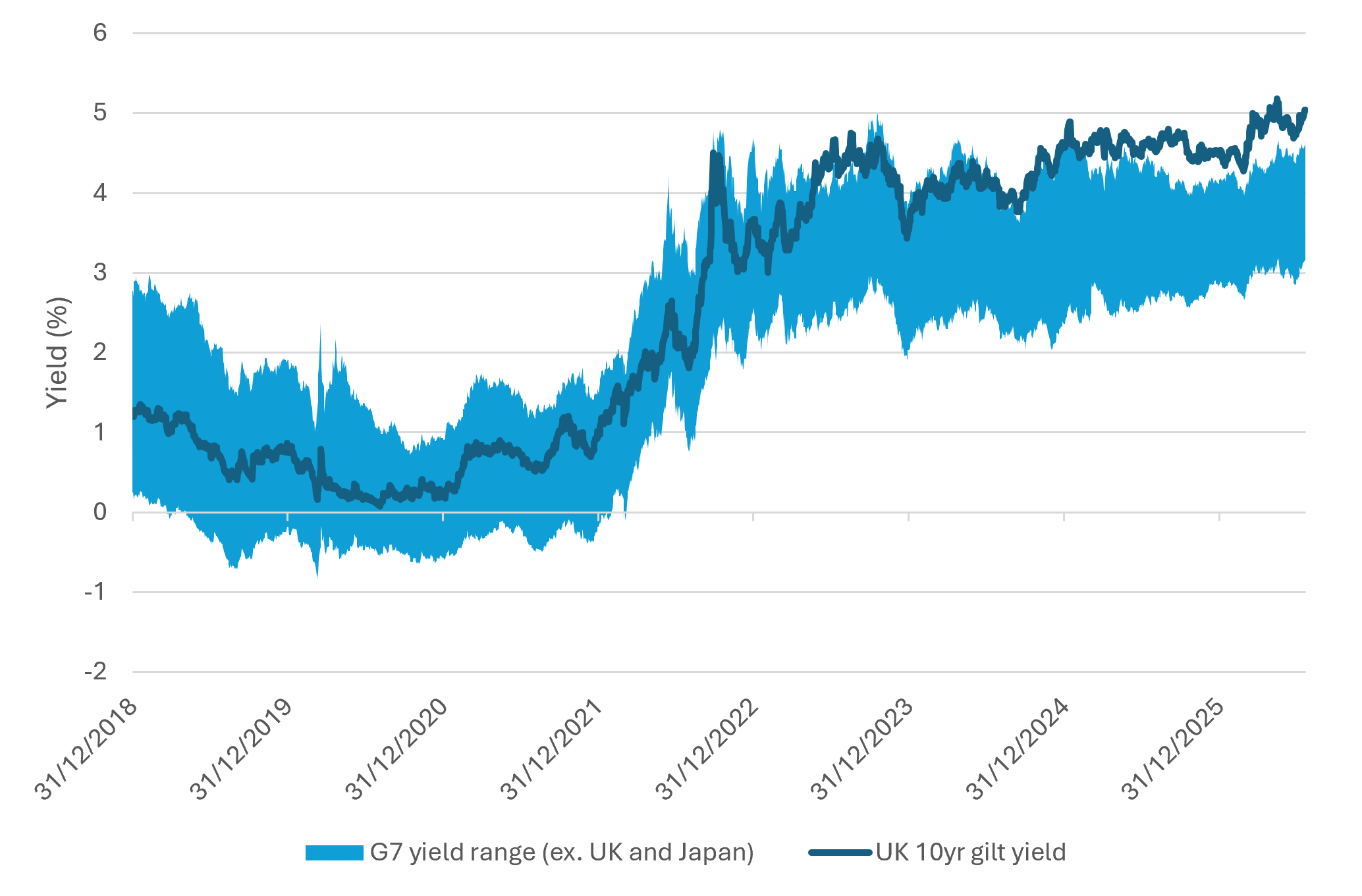
Chart 1: UK cost of borrowing above G7 peers
Source: LSEG Datastream, Quilter Cheviot Limited, 23/7/2026. Past performance is not a reliable indicator of future returns. The value of investments and the income from them can go down as well as up. You may not recover what you invest.
UK 10-year gilt yields have traded at a premium to G7 peers since the second half of 2022, when unfunded tax cuts were announced during Liz Truss’s short tenure. For much of the past year, the UK 10-year yield has been the highest among G7 peers, reflecting concerns about borrowing levels. However, some of this risk is already priced in. If the new government proves fiscally responsible, that premium could narrow and gilt yields could fall.
Domestic politics is important for gilts, but global factors still matter at least as much. We continue to see the appeal of investing across a broad range of fixed income assets.
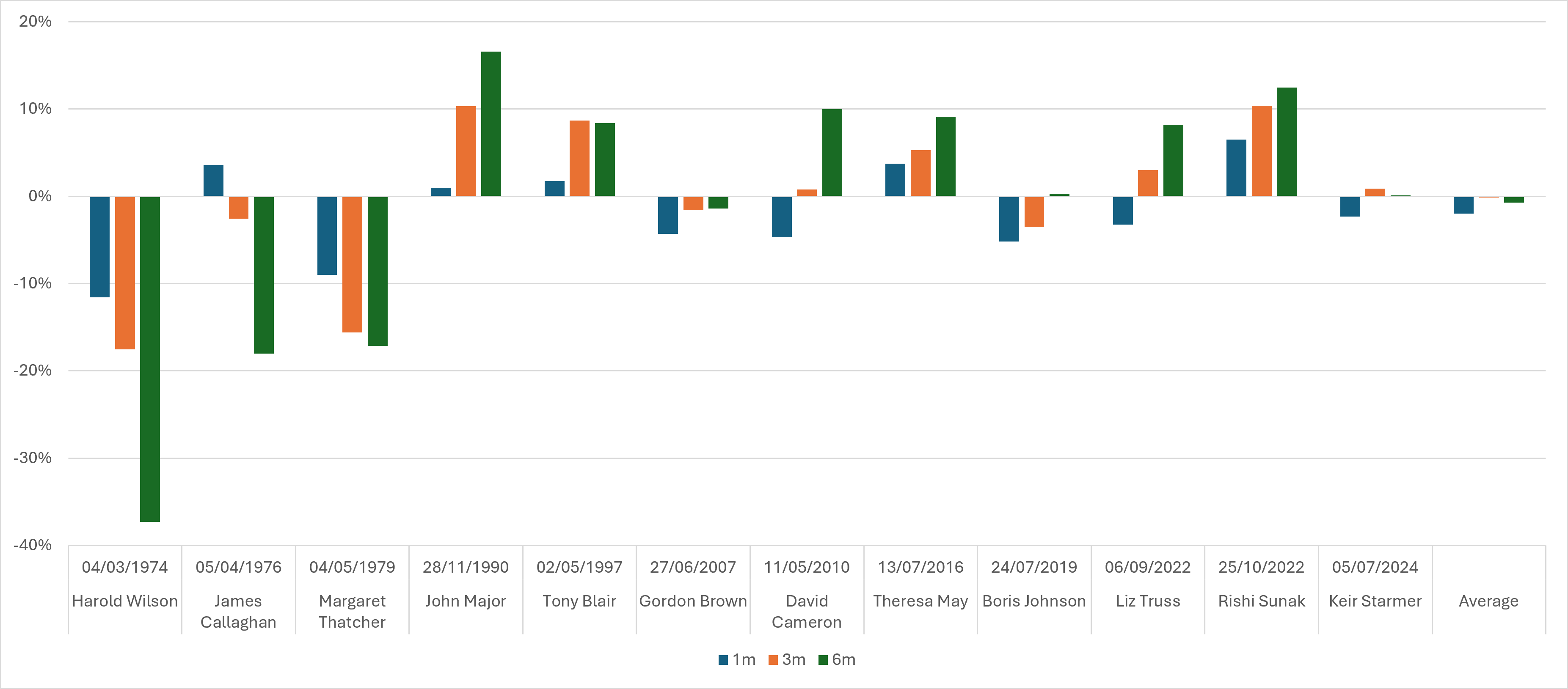
The broad market reaction has so far been muted, with little movement in sterling and only a modest rise in gilt yields. Equity markets tend to respond less to the arrival of a new prime minister than to the surrounding economic and policy conditions. Historically, UK equities have been slightly weaker, on average, in the first month after a new prime minister takes office, but there is little consistency over the following three to six months.
Chart 2: Changing prime minister has had Little lasting impact, on average, for UK equity markets over time
Source: LSEG Datastream, Quilter Cheviot Limited, 23/7/2026. Past performance is not a reliable indicator of future returns. The value of investments and the income from them can go down as well as up. You may not recover what you invest.
There have been sharp moves in both directions. The sell-off after Harold Wilson came to power reflected a very different backdrop of political and economic turmoil. During Liz Truss’s short tenure, markets reacted strongly to unfunded tax cuts before recovering after Rishi Sunak took office and uncertainty eased.
Eight of the last nine prime ministers have seen UK equities rise six months after entering office, with the only decline under Gordon Brown being modest. However, these moves reflect many drivers, including global markets, not just domestic politics. The sector-level impact is likely to be more important once policy becomes clearer.
Since the end of April, when political uncertainty pushed gilt yields higher, UK utility stocks have returned -5%, compared with +3% for the UK market and +2% for European utilities. Performance has been stock-specific, reflecting perceived exposure to political reform. National Grid has held up better, given its focus on electricity grids and significant US exposure, while Centrica has lagged because of its large retail supply business.
Water companies have been more resilient than expected despite appearing vulnerable to reform, partly because a recent regulatory review has already set much of the roadmap for change. The decision to remove VAT on electricity bills should help consumers, but it is more of a cost-of-living measure than a direct intervention in the utility sector.
Full public control of utility companies would be expensive and likely fiscally irresponsible. Buying listed equity across water and electricity firms could exceed £250bn, around 8% of UK GDP, with a similar amount required to fund sector capex over the next five years. Any move in this direction would likely prompt bond markets to price in significantly higher borrowing.
Healey’s appointment is positive for the UK defence sector. As defence secretary, he called for increased spending and resigned from Starmer’s cabinet over a lack of funding. He has previously argued for a clear path to spending 3% of GDP on defence by 2030, compared with the Starmer government’s 2.68% commitment, as a step towards NATO’s 3.5% target by 2035.
Although fiscal priorities are competing, it would be difficult for Healey to leave defence spending unchanged given his prior stance. Depending on allocation, a move to 3% by 2030 could raise defence equipment spending by around £4bn, or 12%, in that year. This would support companies with UK exposure, including BAE, Babcock and Qinetiq. Shares rose on the day of his appointment, but the potential opportunity may not be fully reflected.
UK banks have moved into the political spotlight as investors assess whether a government with limited fiscal headroom may raise more revenue from the sector. However, banks already face a materially higher tax burden than most UK corporates through the bank surcharge and bank levy.
PwC estimates UK banks face a total tax rate of around 47%, compared with 39% in Germany and 28% in the US. This includes corporation tax, the 3% banking surcharge, the bank levy, employer social security contributions and irrecoverable VAT. The industry argues that further increases could undermine the UK’s competitiveness as a banking centre.
Further taxation cannot be ruled out, but the direct earnings impact is often overstated. Returning the surcharge to its previous 8% rate would be a high single-digit earnings headwind for the most domestically exposed banks. Lloyds and NatWest would be most affected, followed by Barclays. HSBC and Standard Chartered would be more insulated given their international earnings bases.
The more important issue is behavioural. Lenders facing structurally higher taxes would likely seek to rebuild returns through wider lending spreads and tighter pricing discipline. That could partly offset earnings pressure for the banks but may also raise borrowing costs for households and businesses, weighing on credit demand and economic activity.
There are potential positives too. Government focus on housing, infrastructure and regional development could support demand for mortgages, SME lending and corporate credit. Stronger nominal growth and stickier inflation could also reduce the likelihood of a return to ultra-low rates, supporting bank earnings. The net impact will depend on whether investors place more weight on stronger growth and higher rates or on fiscal sustainability and valuation risks.
Burnham has previously expressed a desire to increase social housing. Many governments have tried to raise housebuilding and fallen short, with planning, supply constraints and funding persistent obstacles. Greater powers for local or regional councils may help, although the 2024 National Planning Policy Framework already set local targets and freed up strategic land use with limited impact so far.
Housing associations and local councils no longer have the same skills and funding that supported social housing delivery in the post-war period. If Burnham succeeds, landowners and construction companies could benefit, but execution risk remains high.
The new government has not yet set out its North Sea oil policy. Broadly, it could leave the current restrictive framework in place, encourage development of already approved projects, or incentivise new exploration and development. Only the latter two would have meaningful implications for energy companies, employment, tax revenues and emissions.
Given Labour’s previous approach, a major reversal on North Sea policy appears unlikely. Large oil companies such as Shell and BP have significantly reduced their exposure to the basin because of reserve depletion, divestments, heavy taxation and tighter restrictions on exploration. As a result, any policy change would have limited impact on the listed oil majors, but could matter more for smaller UK-focused names such as Harbour Energy, Ithaca Energy, Serica Energy and Enquest.
UK oil and gas production has fallen by around 75% since its 1999 peak, with current oil production at roughly 600,000 barrels per day, or about 0.6% of global output. Around 90% of recoverable reserves in the UK North Sea are understood to have been used. New technology and friendlier regulation could help, but any production increase would likely be limited.
The UK consumer staples sector is dominated by global companies such as BAT, Diageo and Unilever, where UK sales are a relatively small share of revenues. As a result, domestic fiscal changes and UK growth are less important to overall corporate performance.
At the margin, fiscal easing that relieves cost-of-living pressures could help businesses with greater UK or discretionary exposure, including ABF/Primark and Imperial Brands. However, any easing will eventually need to be funded through taxes, spending cuts or welfare changes, creating potential headwinds for some consumers. It is too early to judge whether the tax policy on tobacco or alcohol will be altered, although significant change looks unlikely given broad political support for the Tobacco and Vapes Act.
The outlook for UK food retailers is modestly positive if the government remains focused on easing cost-of-living pressures. The main benefit would likely be stronger demand rather than higher margins, as improved disposable incomes support basket sizes, shopping frequency and promotional participation.
Lower-income households should benefit most from lower electricity bills, reduced energy levies and broader support, given the larger share of income they spend on essentials. This would favour value-led retailers such as Aldi and Lidl, as well as Tesco and Sainsbury’s, which remain focused on own-label ranges and loyalty promotions.
Tariff reductions would also help affordability and volumes, though competition means savings would likely be shared with consumers rather than retained in full. One risk is a tax or levy on large distribution centres, which would raise supply-chain costs for Tesco, Sainsbury’s, M&S and the discounters. Overall, demand risks look favourable, but food price controls and higher logistics taxes remain key profitability risks.
Consumer discretionary — disposable income support is helpful, but tax risk remains (Mamta Valechha)
Burnham’s early agenda is centred on energy bills, household affordability and the cost-of-living. Lower energy costs would lift disposable incomes, while consumer confidence could improve if households believe the government is easing financial pressures. Regional investment and employment initiatives could also support lower- and middle-income spending, benefiting domestically exposed companies such as Next and M&S.
However, the key risk is that any stimulus is offset by future tax increases. The government has announced at 20% cut to business rates for pubs, clubs and live music venues who have been facing significant cost pressures. This cut would be incremental to the 15% cut given in April 2026 and will be implemented in April 2027. For listed pubs such as J D Wetherspoon and Marston's, the support could add 5-10% to EPS, other things being equal. These changes are said to be funded by businesses that do not positively contribute to society, such as vape shops, and businesses who sell through online marketplaces but do not comply with the tax rules would also be investigated. At present we do not have clarity on what establishments qualify, perhaps we will have to wait until the autumn statement for more details. Finally, there has been no mention of hotels, so Whitbread's business rates increase will stand.
We do not expect a major near-term impact on the technology sector from Burnham’s premiership. Further UK investment in IT would be welcome, but the new prime minister appears more focused on other areas of public investment. For international technology companies, the UK is a relatively small market, so direct effects should be limited. We will continue to monitor any government engagement with Big Tech.
While a change in government can influence market sentiment, the overall impact on the wider UK stock market is likely to be more limited than many expect, given that a large proportion of index earnings are generated overseas. Global factors such as economic growth, interest rates, commodity prices and currency movements are therefore likely to remain the primary drivers of returns for the UK's largest listed companies.
The greatest impact is likely to be felt in more domestically focused sectors. Increased investment in housing, infrastructure and regional development could benefit housebuilders, construction companies and UK industrials, although the scale of any benefit will depend on the final shape of government policy. Within housing, changes to planning reform, affordable housing, stamp duty and taxation are all likely to be important. We will also be watching for any changes to business rates.
Fiscal credibility will also be key. If the government can maintain market confidence and keep gilt yields contained, it would provide a more supportive backdrop for interest rate-sensitive areas of the market, including housing, construction and consumer-facing businesses.
Recent press reports have suggested a more pragmatic approach towards North Sea oil and gas production to support energy security and help address cost-of-living pressures. However, this sits alongside the appointment of an Energy Secretary who has historically opposed new North Sea oil and gas licences, highlighting the potential for competing priorities within government.
Defence is another sector likely to remain in focus, with defence contractors responding positively to recent ministerial appointments. More broadly, we are monitoring companies where government spending, procurement decisions or regulation could have a meaningful influence on earnings. Businesses with significant public sector exposure, including outsourcing and support service providers, may continue to experience periods of uncertainty until spending priorities become clearer.
Overall, if the government succeeds in supporting UK economic growth while maintaining fiscal credibility, the outlook for more domestically exposed equities could become increasingly supportive.
Authors

Richard Carter
Head of Fixed Interest Research
Tim Armitage
Investment Strategist
Phil Ross
Equity Research Analyst
William Howlett
Equity Research Analyst
Oli Creasey
Head of Property Research
Maurizio Carulli
Equity Research Analyst
Chris Beckett
Consumer Staples Analyst
Lucy Rumbold
Equity Research Associate
Mamta Valechha
Equity Research Analyst