The page you were trying to view is not available for your role and region.
In Mary Wesley’s ‘The Camomile Lawn’, Aunt Helena takes advantage of plummeting property prices during the Blitz to buy two adjacent houses in Chelsea for £2,000. Some investment. Even after taking inflation into account, £2,000 back in 1940 was equivalent to £100,499.79 in August 2026, according to the Bank of England Inflation Calculator. And that was for two properties, implying each cost Aunt Helena a little over £50,000 in today’s money. Compare that with the £2m average house price in Chelsea quoted by Rightmove today, and Aunt Helena turned out to be a shrewd property investor.
Aunt Helena’s purchases may have been fictional, but they were not far off the mark. Winston Churchill acquired a house in Kensington just after World War II for £7,000. And who hasn’t heard of ‘fortunes’ being made from property around the dinner table? At the headline level at least, the property investment case has legs. But headlines rarely tell the whole story, and this is true of property. For there are key considerations to bear in mind before deciding if property investment is for you. After all, not everyone is like Aunt Helena.
1. Beware of biases
Property is a national obsession and perhaps because of this it is also an emotive subject. So much so that behavioural biases can kick in:
- Herding: Following others into the market because property ownership appears successful.
- Anchoring: Relying on a purchase price, past valuation or an isolated statistic.
- Endowment effect: Placing additional value on an asset because it is already owned.
- Familiarity: Assuming experience of owning a home translates into expertise in property investment
Emotions and behavioural biases can lead to sub-optimal investment decisions being made.

2. Nothing goes up in a straight line
Looking at Aunt Helena’s house purchases can give the impression that property only goes up in a straight line. But as the chart below shows, even though the average property price (all types) in the UK has risen from £30,000 in the 1980s to £300,000 in 2025, property can have long periods of decline and stagnation. Take 1989, anyone purchasing a property then would have got in close to the top of the market. Over the following three-year period, property prices across the UK fell on average by 12%.
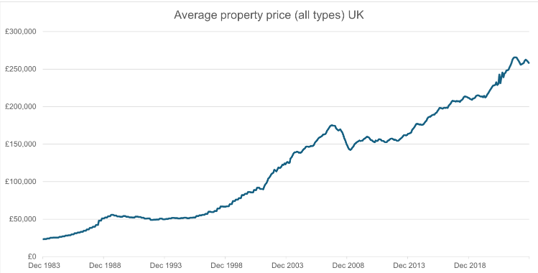
Source: Land Registry
Other assets, such as equities, can fall by 12% or more but what is telling is that it took seven and half years for the average property to recoup the ground lost. And 1989 was no one off. Following the 2007/08 Global Financial Crisis, UK property prices fell 19% over an 18-month period and took around seven years to recover. For most other mainstream asset classes, particularly those purchased to capture the benefits of diversification and minimise risk, a seven plus year recovery is rare.
The potential for extended downturns therefore needs to be understood. As does the wider issue of liquidity risk. Selling property takes time: a couple of months in a fast market; more like six plus in a slow market. And linked to this is concentration risk. While investments held in a pension or ISA tend to include different asset classes to minimise risk, direct property investments, by definition, are not.
3. Property is not the only investment in town
Based on the above chart, property generated an annualised return of around 6.3% between 1980 and 2025, a decent outcome that compares favourably with the +5.3% annualised return generated by UK large-cap stocks over the same period. But if dividends paid out by UK companies were reinvested into the stock market, then the annualised total return for UK large caps jumps to a property-beating +7.4%.
It is important to assess the relative attractions of property against other asset classes.

4. What’s the real return?
When assessing if property is a good or bad investment, costs and taxation need to be considered. As the graph above only charts headline price growth, it does not include the various monetary costs that come with investing in property. There are time-related costs too. But how can personal time spent managing and maintaining properties be priced? Should it be the cost of employing a management agency which is typically 10-15% of rent plus VAT? Variables such as these and those in the table below mean it is not easy to calculate a total return on property:
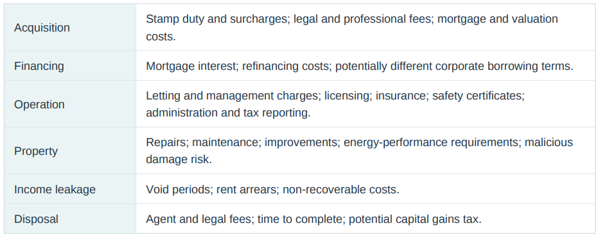
Because of the above, the average property investor is unlikely to have locked in the above 6.3% return each year, even before taxation of rent and capital gains tax on sale.
5. An ever-changing regulatory and tax environment
When Aunt Helena first bought her properties in 1940, she would not have had to arrange Energy Performance and Safety Certificates for her properties. Nor would she have had to comply with the Renter’s Rights Act of 2025 (the ‘Act’), which includes abolishing ‘no-fault’ evictions, replacing fixed-term tenancies with periodic tenancies, and strengthening tenants’ rights over rents, property standards and security of tenure. Additionally, the Act introduces compulsory registration of private landlords and their rental properties on a new national database, whilst in Scotland, rent controls are a new feature of the system.
These are just examples of recent regulatory changes. Who knows what changes will come into force in the future.
The same is true for taxation. The last 20-30 years have seen considerable change in the tax regime for landlords. The cumulative effect has been a squeeze on profitability. To see how, consider the introduction of Section 24 of the Finance Act 2015
Prior to 2017, landlords could lower tax bills by deducting mortgage interest from rent.
|
If rent received was £10k pa. but mortgage interest was £8k pa, a higher rate taxpayer would pay tax on the difference (40% of £2k = £800). |
With the introduction of Section 24 landlords are given a basic rate tax credit on the mortgage interest but pay full tax on rental income.
|
40% tax on £10k rental income (£4k) - basic rate tax credit on the £8k (£1,600) = a tripling in the tax bill from £800 pa to £2400 pa. |
Section 24 means lower net returns where properties are funded with mortgages. And a further squeeze is on the way in the form of a 2% increase in the rental income tax rates from April 2027. The point is no one can know what the tax and regulatory landscape will be in the future.
6. Minimising tax—easier said than done
Sheltering multi–asset portfolios from tax is relatively straight forward thanks to tax wrappers such as ISAs and pensions. Doing the same with property is more complicated. Often the promise of lower tax bills leads to trade-offs elsewhere.
Take holding property in a company. On the face of it, this ought to enable the investment to benefit from full mortgage interest tax relief as companies pay tax on profits which can be offset with legitimate fully tax-deductible business expenses, such as interest costs. But there are trade-offs, for example, a potential capital gains tax (CGT) liability.
CGT is traditionally incurred when ownership of an asset changes. Transferring property into a company marks a change of ownership and so is treated as a disposal for CGT purposes (CGT is not chargeable on private residences but is on rental properties). It is possible to avoid a CGT charge by claiming incorporation relief. To claim this under Section 162 of the Taxation of Chargeable Gains Act 1992, HMRC will have to be convinced that any properties were not held as passive investments but managed as a business. Only once all the boxes have been ticked (and with the right advice) might it be possible to transfer existing properties into a company without crystallising a CGT charge. Even then, any CGT liability is only deferred until the property is disposed of. Further Stamp Duty Land Tax may also apply unless the property before transfer was owned for a period of time via a partnership.
The above is just one example of how going down one route (holding property in a company) may have benefits (mortgage interest tax relief) but will likely have implications elsewhere (CGT charge). And as well as CGT and stamp duty, there is corporation tax, inheritance tax, financing and legal ownership issues to consider, as well as tax when profit is extracted from a company.
It doesn’t have to be binary
The main takeaway from the above is don’t be dazzled by headline price growth. Factors such as net return, risk, structure, administration all need to be considered, and not just those of the property in question, but also those of available alternatives too.
And speaking of alternatives, it is possible to hold a multi-asset portfolio that includes property-related securities alongside equities and bonds. This way, liquidity and concentration risk associated with direct property investment can be minimised, while exposure to the asset class can be gained. And if the portfolio is held in a wrapper, such as a pension, then not only can returns that match the investor’s risk appetite be targeted, but they can be generated in a tax-efficient manner too. So often, investors are faced with an either/or choice—buy this or buy that. With property, it doesn't have to be this way. We might not all be like Aunt Helena but then again, we don’t have to be.
If you would like to view our recent webinar on property, featuring Head of Technical David Denton, and Chartered Financial Planner, Ian Cook. Please sign up here to watch on demand: Property: Is the door to building wealth closing?. Please note, this webinar is intended for private individuals who do not have a relationship with Quilter Cheviot and do not have a financial adviser, if you already have a financial adviser please always consult them on your requirements first.
This is a marketing communication
Trusts, Estate planning, some Buy to Let Mortgage, Taxation and Inheritance Tax Advice are not regulated by the Financial Conduct Authority.
Investors should remember that the value of investments, and the income from them, can go down as well as up and that past performance is no guarantee of future return. You may not recover what you invest.
This material is not tax, legal or accounting advice and should not be relied on for tax, legal or accounting purposes. Quilter Cheviot Limited does not provide tax, legal or accounting advice. You should consult your own tax, legal and accounting adviser(s) before engaging in any transaction.