The page you were trying to view is not available for your role and region.
Global government bond markets have been under the spotlight lately as rising debt burdens and growing concerns over the sustainability of current fiscal trajectories have driven yields to multi-year highs. With a UK Budget on the horizon (28 October) and the market fallout from the Truss/Kwarteng 2022 “mini-Budget” still relatively fresh in the memory there is an understandable concern among some about a repeat event. However, for now, this looks highly unlikely.
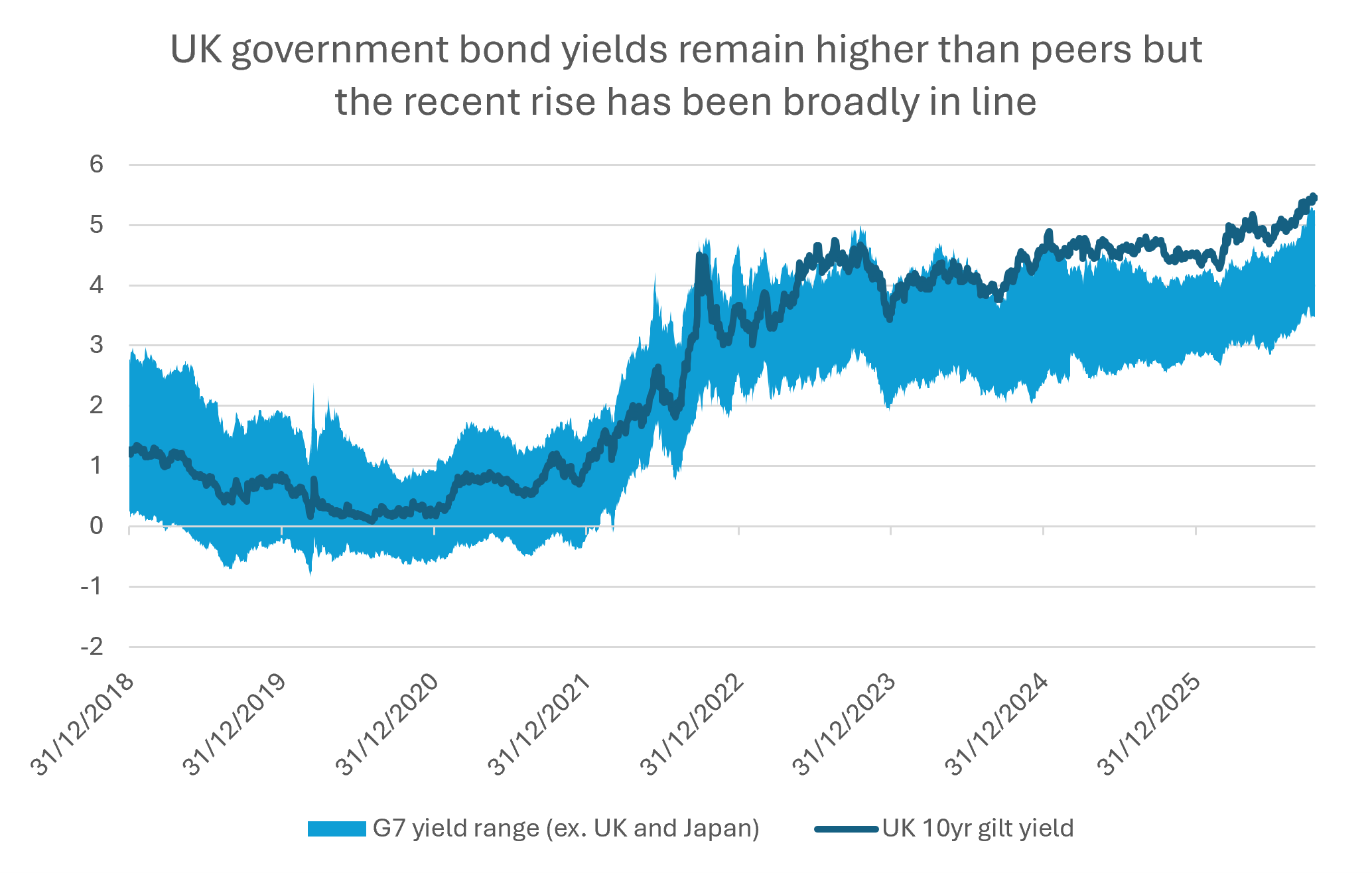
While UK government borrowing costs have risen further since last year’s Budget, the rise in yields has been in line with, or in most cases slightly less, than other major economies. 30-year gilt yields have increased by around 60 basis points (0.6%), compared to 70-100 basis points for other comparable sovereign bonds, according to Barclays.
Global factors the main driving force
The rise in yields has been a global phenomenon, mainly reflecting expectations for higher inflation (and accordingly higher central bank policy rates) due to the energy price shock from the conflict in the Middle East. The latest UK Consumer Price Index showed a 3.5% year-on-year (Y/Y) increase and markets are pricing a rise to around 4.5% in early 2027. Due to the openness of its economy and its reliance on energy imports the UK tends to be more sensitive to external shocks of this kind than the US and Eurozone and therefore it is expected that UK inflation will stay higher for longer than these peers. Due to inflation moving further from the Bank of England’s 2% target, markets are pricing three to four 25 basis point increases in the Bank of England base rate over the next 12 months. This has undoubtedly contributed to the rise in UK yields.
Source: LSEG Datastream, Quilter Cheviot Limited, 14 October 2026. Past performance is not a reliable indicator of future results. The value of investments and the income from them can go down as well as up. You may not get back what you invest
Having said that, the UK is no longer facing the most scrutiny from global bond markets, with other governments, notably the US and France taking centre stage. Although UK yields remain higher than those on US and French debt, the premium is smaller than it was 12 months ago.
|
|
UK 10-year yield |
US 10-year yield |
France 10-year yield |
|
13/10/2025 |
4.66% |
4.06% |
3.47% |
|
13/10/2026 |
5.45% |
5.22% |
4.84% |
|
Change |
0.79% |
1.16% |
1.37% |
Source: LSEG Datastream, Quilter Cheviot Limited, 14 October 2026. Past performance is not a reliable indicator of future results. The value of investments and the income from them can go down as well as up. You may not get back what you invest
From 13 October 2025 to 13 October 2026 the 10-year gilt yield has risen 79 basis points compared to a 116 basis point rise and 137 basis point rise for the US and French equivalents respectively. This suggests that the risks of a domestic catalyst for a gilt sell-off have decreased.
What is more, for investors the current higher yield levels provide a sizeable cushion to protect against larger losses, like those seen in 2022. The 10-year gilt yield rose 96 basis points to 5.44% in the first nine months of 2026. That translates into a -2.4% return. In 2022, a starting 10-year gilt yield of 1% meant that a similar 96 basis point increase would have generated a total return of around -6.4% — a loss more than twice as large. Simply put, starting yields matter.
UK growth pushing ahead
Turning our attention to the UK economy and things are perhaps not quite as bad as many would believe. The UK was the fastest growing G7 economy in the first half of 2026, with GDP expanding by approximately 1.1%. Pleasingly, indications for Q3 are also positive, as in the previous two years strong first half growth fizzled out, in part due to uncertainty around tax increases at the Autumn Budget. The 2.1% Y/Y GDP growth rate to the end of August is the fastest pace in almost four years and while the UK is not at the forefront of the AI boom, there are signs it is still reaping significant economic benefits. Around half of the UK’s annual growth rate can be attributed to AI-related areas including computer programming, legal activities and scientific research and development. Furthermore, UK GDP growth was recently upgraded by the International Monetary Fund (IMF) from its July forecast, and the US is the only G7 country expected to post a higher growth rate for 2026.
UK to have smallest G7 deficit
Source: LSEG Datastream, Quilter Cheviot Limited, 16 October 2026. Past performance is not a reliable indicator of future results. The value of investments and the income from them can go down as well as up. You may not get back what you invest.
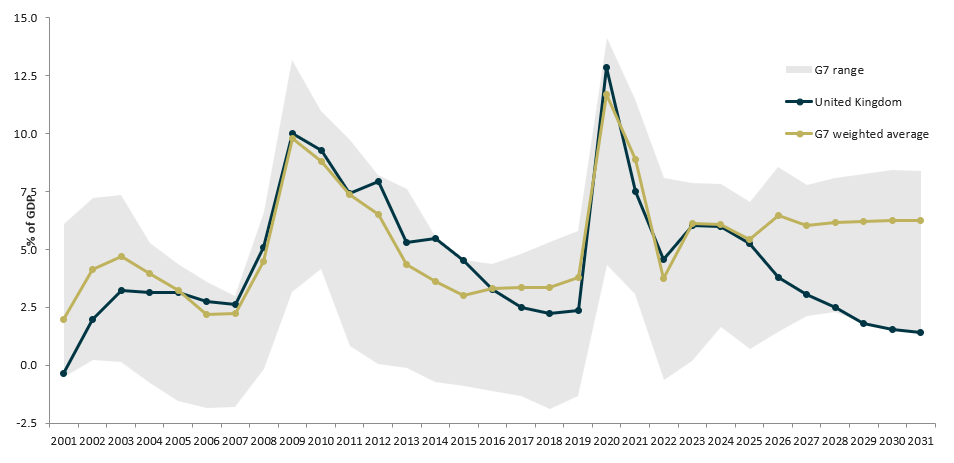
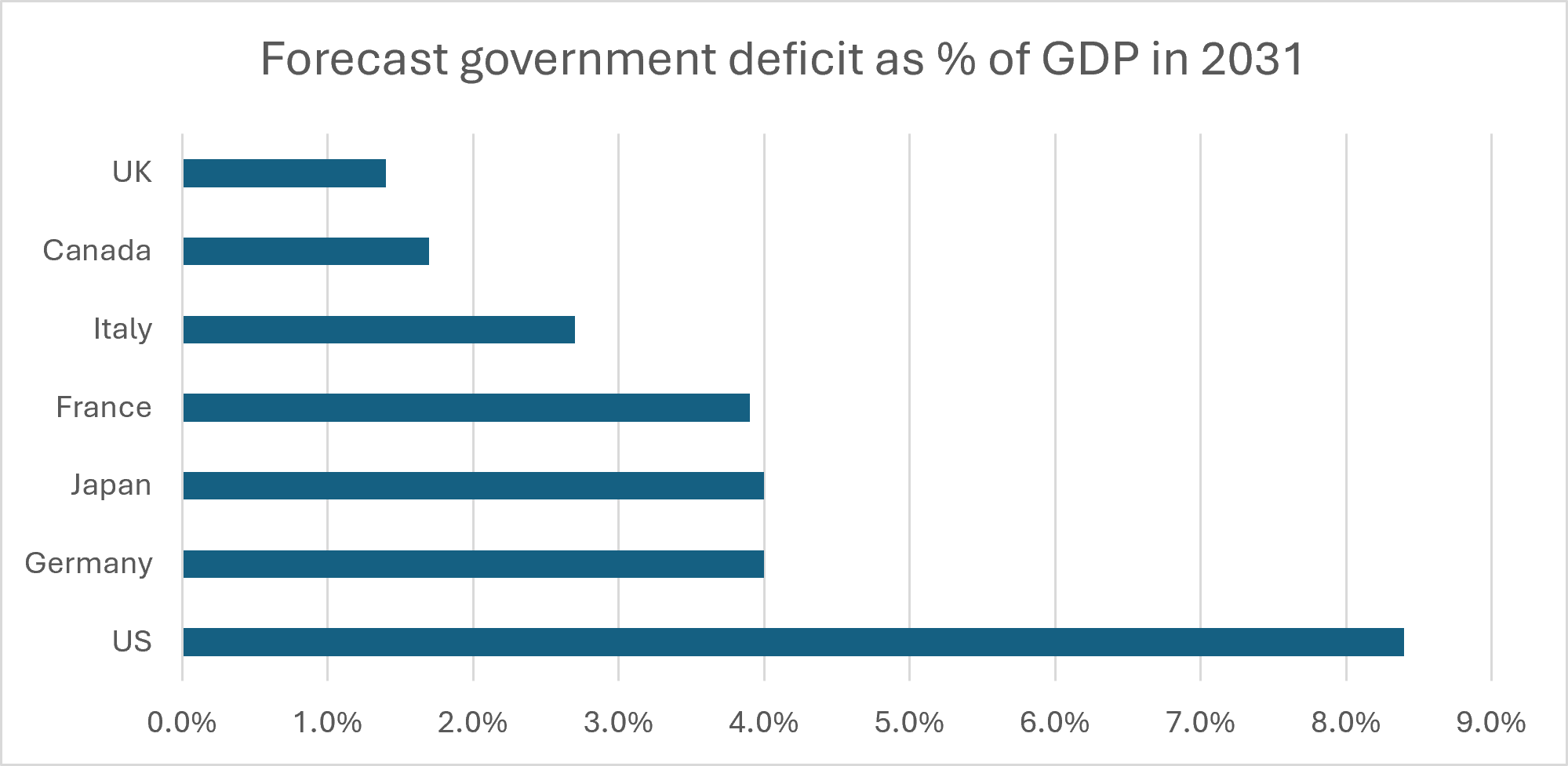
While resilient, stronger-than-expected growth has contributed to higher bond yields this year, expected future government borrowing has been a greater concern for markets. We have seen this several times before, most recently with the market fallout from the 2022 Budget when plans for unfunded tax cuts spooked investors. Reassuringly then, the UK is now seen as being one of the most responsible governments when it comes to borrowing plans. In the medium term, shown by five-year ahead IMF forecasts, the UK is expected to have the smallest G7 fiscal deficit at 1.4% — substantially lower than several peers.
Source: IMF World Economic Outlook, Quilter Cheviot Limited, 14 October 2026. Past performance is not a reliable indicator of future results. The value of investments and the income from them can go down as well as up. You may not get back what you invest.
It should be said that a lot can happen in five years, but it is welcome nonetheless that UK government spending is currently expected to be on a far more sustainable path going forward than several of its peers.
Budget not expected to see large borrowing increases
Tax and spending changes often dominate the headlines after a budget but for bond markets it’s the level of borrowing that is most important. In this regard, the upcoming Budget on 28 October is not expected to contain sizeable borrowing increases and therefore UK government bond markets have been fairly sanguine of late.
Although surprises can occur there are growing indications that this will not be as big a fiscal event as the last two budgets under Chancellor of the Exchequer Rachel Reeves which saw a combined £66bn in tax rises. These tax increases came alongside substantial increases in government borrowing, which together funded a largescale increase in government spending.
This additional borrowing was earmarked for increasing government investment by approximately £25bn a year, a move intended to prevent investment falling as a share of GDP, as was planned by the previous government. Following this, increased debt-service costs due to rising yields on government debt meant that the relatively small fiscal headroom that Reeves had left was diminished further. This led to the November 2025 Budget seeking to replenish this buffer, which came more from another round of sizeable tax increases rather than significantly higher borrowing.
This time around, the level of fiscal headroom will be one of the main areas of focus due to the aforementioned rise in government bond yields and resultant increase in debt-service costs. Exact figures are not publicly available, but around half of the £23.6bn fiscal headroom is expected to have been lost, according to estimates by the Financial Times. Promises to maintain fiscal control from Chancellor of the Exchequer John Healey have been taken as indications that the existing fiscal rules will be respected. But questions remain as to whether Healey will look to fully replenish the fiscal headroom to its previous level or use the Middle East conflict as a reason for it to be used, at least partially, to protect against the shock.
Conclusion
The upcoming UK Budget is not expected to be as big an event as the last two years, but we remain watchful and ready to act should surprises occur. Remarks from Chancellor of the Exchequer John Healey and UK Prime Minster Andy Burnham have suggested that largescale changes are more likely to occur further down the line. For bond investors there will be a keen focus on any changes to existing borrowing plans, with tax and spending decisions receiving less attention initially
Recent strong economic data is pleasing and gives the Bank of England some additional room for manoeuvre as they seek to find the delicate balance of imparting downward pressure on inflation without choking off economic activity. Tax increases can be seen as a headwind to economic growth, but rises in recent years have been countered by the tailwind of higher government spending, which has risen relatively more due to borrowing increases. Therefore, in the absence of additional borrowing, tax increases could have a more detrimental effect, and Healey will no doubt be mindful of this heading into the Budget.
The UK’s fiscal credibility took a substantial blow following the 2022 “mini-Budget” but since then the government has followed a path that is seemingly acceptable to financial markets. This can be seen by the premium commanded for UK government borrowing remaining stable, or in some cases falling, against its peers. While recent rises in UK yields are a potential cause for concern, it is reassuring that gilts have held up better than some peers (US and France) in what can be taken as a relative show of confidence from the markets.
Some doubts still remain though as this is the first Budget under a new chancellor but should Healey show himself to be fiscally prudent at a time when several of his counterparts are being anything but, then there is a fair chance that UK yields can continue to close the premium gap against several peers.