The page you were trying to view is not available for your role and region.
Almost four years have passed since the artificial intelligence (AI) trade began in earnest and, while it has been the dominant positive catalyst driving stocks higher during this time, there have been seven major pullbacks along the way.
The most recent pullback can be largely attributed to growing concerns around the increasing use of debt financing used to fund capital expenditure (capex) and worries about constraints on providing the power required to run the technology. Although we share these concerns, we believe that the investment case in this area remains attractive, albeit not as compelling as it was three to four years ago.
OpenAI’s November 2022 launch of ChatGPT turbocharged the post-pandemic stock market rally and given the levels of hype and excitement surrounding AI it should not be too surprising that we have periods when this cools somewhat. Changes in sentiment are not unusual and are the reasons why markets do not move in straight lines.
Chart 1: The MSCI All Country World index has experienced declines in excess of 10% in 15 of the last 25 calendar years, although on only three occasions did the index end the year down 10% or more
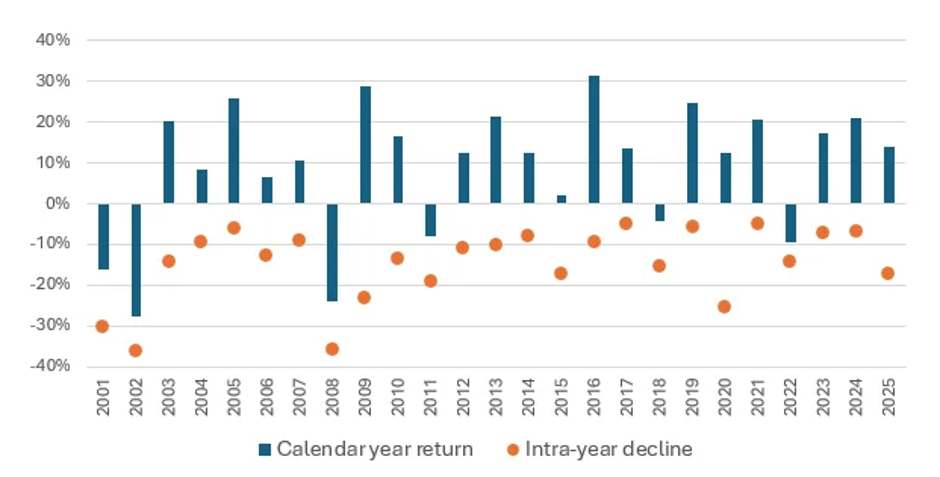
Source: LSEG Datastream, Quilter Cheviot Limited, 31 December 2025. Past performance is not a reliable indicator of future results. The value of investments and the income from them can go down as well as up. You may not get back what you invest.
At present, markets are displaying a heightened sensitivity to even relatively small changes in AI sentiment. This is due not only to the keen interest in the area but also because of the large gains seen in recent years and substantial weightings of a number of stocks heavily exposed to the theme in the largest stock market benchmarks.
What is more, we have seen a growing influence from AI developments on a wider range of investments of late. As the AI trade broadens out a larger number of stocks are being affected and the recent weakness emanating from AI stocks could even be seen in supporting government bonds as markets entered into risk-off mode. AI-related investment contributed around 50 basis points (0.5%) to the 2.0% US real GDP growth in 2025, according to the IMF. As this only accounts for the direct investment effect, the overall impact may be larger still. While this has been a key growth driver of late, investment levels remain a relatively small proportion of the overall economy, approximately 1.5%.
Chart 2: AI diffusion through the tech stack
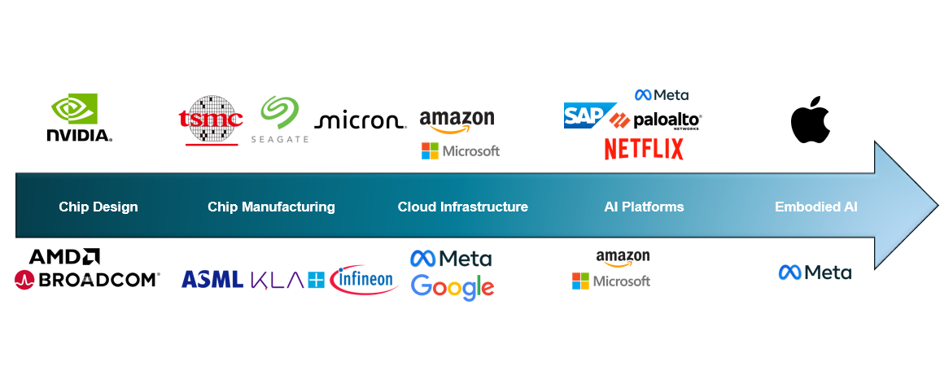
Source: Quilter Cheviot Limited, 31 August 2026. Past performance is not a reliable indicator of future results. The value of investments and the income from them can go down as well as up. You may not get back what you invest.
From an investment perspective we believe that while sentiment swings can drive short-term market returns, fundamentals are far more important in the long term. Therefore, we continue to focus on assessing the positives and negatives — the pros and cons — of the investment case for AI.
Seven potential AI trade concerns
Rising levels of debt issuance — Initially the majority of capex came from large firms’ free cash flow, but this has begun to change. In 2027, around 20% (US$200bn of the expected US$1tn) of AI capex is expected to be financed by debt.
Circular financing — The interconnected nature of businesses at the forefront of AI development is a potential red flag. The justification offered for this by firms engaged in direct lending and investment between themselves is that the larger players are using their balance sheet to smooth the development of the industry. However, it does raise the risks involved as it increases exposure, but for now it remains containable.
Power, grid, permits, land and labour — Constraints on the building and usage of data centres are growing and therefore slowing down the potential usage of AI technology. The availability of power is the key constraint and the power firms are working hard to fill any gap between data centre demand and power supply.
Politics — At the local/state level political pressure has been mounting against the building of tech infrastructure. An example of NIMBY — not in my back yard. Federally, the Trump administration has been generally pro the infrastructure build-out and should the Republicans lose control of one, or both, houses after the upcoming mid-term elections then the backdrop may not be as favourable. At state level, it is important for the DC builders to engage properly with communities to make clear the tax, economic and employment benefits as well as properly address any noise, power or construction pushback.
Safety & regulation — As perceived risks from AI errors increase — due in no small part to prominent industry figures publicly flagging these — there has been an increasing focus in this area. An analogy to the motor industry may apply here, whereby the initial focus was almost solely on performance and reliability but over time safety assumed a more pressing role, leading to the invention of seatbelts, ABD brakes and airbags etc. For now this appears to be having a relatively small impact on industry growth, maybe slowing developement from very fast to fast, and it appears it would take a major, highly unexpected event — a black swan — for a drastic influence from this space. We watch Washington regulation carefully.
Open-source nature creating pricing pressures — From an investment perspective, future profits of current market leaders are potentially vulnerable to cheaper alternatives providing similar technologies. Some AI technology is open source, meanings that the construction of many models is publicly available and therefore open to imitation. We saw this with the Deepseek shock in January 2025 (one of the aforementioned pullbacks in AI-related stocks). However, many tasks require the best answers and therefore the best models.
Rising interest rates — Expectations for the path of interest rates have shifted materially during 2026 and further rate increases are now forecast in the next 12-18 months. Higher bond yields and a less supportive rate outlook can weigh disproportionately on companies whose valuations depend on profits expected far into the future. Rates have gone from a tailwind to a headwind.
Seven potential AI trade positives
Improving model performance — There are plenty of signs of models continuing to improve, scoring higher on exam-style benchmarks and solving longstanding mathematical problems. Recursive self improvement is the holy grail here, the idea being; AI helps improve AI → improved AI becomes better at improving AI → cycle repeats. However it is vital to have human oversight and testing.
AI and token usage — which has doubled in the past three months, reflects demand for AI computing and continues to rise quickly.
Capex growth — Better outcomes and wider adoption are leading to increasing levels of capex. AI-related capex is forecast to rise to US$1.2tn in 2027 from US$800m in 2026. This is clearly beneficial for companies receiving a significant amount of this spend. The five so-called hyperscalers — Alphabet, Amazon, Meta, Microsoft and Oracle — are expected to spend US$4.2tn in the four years ending 2029, according to analysts’ estimates on FactSet.
Rising capex returns — One of the reasons for the growing use of debt financing. Revenue and earnings growth can be seen coming through in a number of places. For instance, Anthropic declared an annualised run rate of >US$60bn at the end of July 2026, a seven-fold increase from just over US$9bn at the end of 2025. We have seen a similar number at Open AI (ChatGPT) as well as accelerating revenues from the major hyperscalers who are able to monetise a data centre once it is completed and switched on.
Rising memory and GPU prices — AI requires large quantities of computer memory and processing power, and demand is currently outstripping supply, pushing prices of each higher.
Valuations remain reasonable — US tech indices are trading on around a 19.8x forward price/earnings (P/E) multiple for 30% growth. This is far removed from the 60X P/E multiple seen in 1999 around the dotcom bubble and compares well to the broader S&P500 on 18.3x for 16%.
Positive earnings revisions — Stocks have experienced a large increase in earnings expectations this year, with US benchmark forecasts more than doubling to 32.8% growth for 2026. This has meant that even though stocks have gained in 2026, P/E ratios have declined, with the de-rating due to the numerator (P - price) rising less than the denominator (E – earnings). In short this rally has been driven by earnings not valuation.
Six key things to watch
Actions & numbers — over words and headlines. We look for clear, accurate data reflecting the latest developments rather than hyperbole and speculation.
Earnings revisions — While recently this has been a positive, we will be keeping a close eye to look for any signs of deterioration, or even further improvement.
Signs of peak capex — Similarly, signs that capex has plateaued, or is even experiencing slowing growth could be seen as a potential warning.
Returns on investment — As the AI trade matures this will become of growing importance, particularly revenue growth of large language models (E.G. Anthropic, Open AI etc.) and non-tech adoption.
Safety & regulation — Any signs that this is becoming prohibitive to growth in a meaningful way.
Non-tech AI adoption — Over time the AI trade will become further reaching, ranging from areas like the replacement of call centres with chatbots to the research and development process of drug discovery. Focusing purely on the tech angle risks missing the bigger picture.
Conclusion
AI has supported equity markets and economic investment in recent years, but the scale of the expansion is creating new risks alongside the opportunities. Even if AI proves to be one of the most transformative technologies of its generation, returns are unlikely to be distributed evenly across the companies involved.
The balance of risks has become less favourable than it was three or four years ago. We therefore believe investors should distinguish between different parts of the AI ecosystem rather than treating it as a single trade. To date, we have generally favoured suppliers such as chipmakers and semiconductor-equipment manufacturers that have benefited from strong demand and constrained supply, although these dynamics can change.
Diversification across sectors and within technology allocations can help limit exposure to any individual AI provider, chipmaker or part of the infrastructure chain. We will continue to monitor earnings expectations, capital spending, returns on investment, financing conditions, regulation and adoption outside the technology sector. The relevant metrics will evolve, but our focus remains on the long-term fundamental drivers of investment returns.