The page you were trying to view is not available for your role and region.
US President Donald Trump essentially has lost control of both the Senate and the House of Representatives following the midterm elections, altering the political backdrop for the world’s largest economy. The result, which was partly anticipated by markets, is expected to have a number of investment implications, potentially impacting stock markets in general, as well as specific sectors including technology, defence, utilities and healthcare as well as government bond markets.
Want to know more?
We are hosting a webinar on Tuesday 10 November 2026 where our in-house and external experts, including Sky News' US Correspondent David Blevins, will offer their perspectives.
Results — A Democratic sweep
Democrats had been polling strongly in the run-up to the vote, but the final result was a more comprehensive victory for the party than many had expected. In total 470 congressional seats were contested — all 435 seats in the House of Representatives and 35 of the 100 Senate seats. By the morning of Thursday 5 November morning the Democrats had won 240 House seats, an increase of at least 30 seats from the 2024 election and comfortably above the 218 mark required for a majority. In the Senate the Democrats won 54 seats, a gain of seven, comfortably exceeding the 51 needed for a majority.
In a sign of the changing tide, several of the House districts won by the Democrats had seen double-digit wins for Trump just two years ago. And it was not just the size of the swings that surprised. Staunchly Republican states including Texas, South Carolina and Kansas recorded Democratic Senate wins.
As is often the case, front and centre of voters’ minds was the economy, according to opinion polls. While headline economic growth appears impressive, the rising cost of living was a crucial or major factor for nine in 10 voters. Two-thirds of respondents blamed Trump’s policies, such as the war in the Middle East, for higher inflation.
While his name was not on the ballot, Trump put himself at the forefront of the vote in several races and as such the outcome is clearly also a reflection of the president’s popularity. The resounding margin of victory is such that it appears unlikely that Trump can contest it. The final two years of Trump’s second term will now play out against a backdrop of diminished political power, seemingly reducing his ability to shape and enact his legislative agenda, although significant executive powers remain with the presidency.
There has been some talk that Democratic-controlled chambers could lead to congressional investigations into Trump, including his personal financial interests and actions taken by his administration. Regardless of the outcome, this would increase hostility between the president and Congress and would be expected to lead to a more volatile and unpredictable relationship.

Market implications
Historically, financial markets have typically responded positively to midterm elections, with rises seen in US equities and US Treasuries. Treasury yields move inversely to prices. In the three months following the midterms, US equities have rallied in 19/24 cases while US Treasury yields have declined in 12/16 cases.
Three-month average move in equities and interest rates following US midterms
|
Congressional outcome |
US equities |
US Treasury yield |
|
Opposition wins both chambers |
5.6% |
-16bp (-0.16%) |
|
Opposition wins one chamber |
3.0% |
-24bp (-0.24%) |
Source: LSEG Datastream, Quilter Cheviot Limited, 4 November 2026. Past performance is not a reliable indicator of future results. The value of investments and the income from them can go down as well as up. You may not get back what you invest
Of course, not all situations are equal, and this historic view does not account for the possibility of events altering the path, such as either a de-escalation or escalation of the Middle East conflict.
Returns for the day after the midterms election
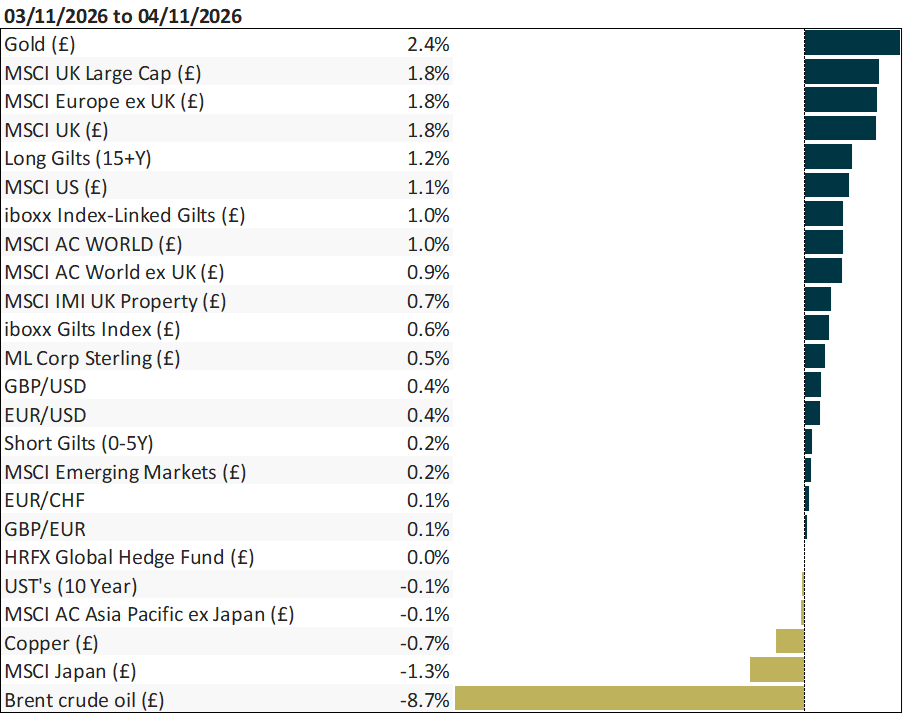
Source: LSEG Datastream, Quilter Cheviot Limited, 5 November 2026. Past performance is not a reliable indicator of future results. The value of investments and the income from them can go down as well as up. You may not get back what you invest
There was some initial weakness in US equities as the election outcome became clear, although this had reversed by the time of the Wall Street open and the MSCI North America ended the day after the election up 1.1%. Key investment risks include higher regulation, rising taxes and permit costs and slower data centre development, which could weigh on growth expectations. However, in the near term these appear to be outweighed by raised hopes of a de-escalation in the Middle East which could be seen in the 8.7% daily decline in Brent Crude oil.
Technology and the AI trade
There are two main areas within the technology sector where the election outcome could be felt. First, data centre construction which mainly attracts opposition due to generous tax incentives for firms and the potential increase in energy prices for residents. This has increased the need for community engagement and if handled in the right manner is not necessarily too prohibitive to data centre construction.
Approximately 39% of planned US data centre capacity expansion falls in Texas, Georgia and Ohio — three states where the Democrats made significant gains. Texas, where Democrats won the governorship and Senate seat is responsible for the lion’s share of this, with 27% of total capacity increase forecast to occur in the state.
Texas has been a popular choice for data centres, so any limitations or additional regulations put in by the Democrats could hamper what has become a burgeoning industry. However, Greg Abbott, the Republican incumbent has already made some moves in this regard, effectively already slowing the rollout so it is not a complete step change.
At the Federal level, with Democrats now controlling both the House of Representatives and the Senate, there is an increased chance of additional regulation of the tech companies. AI safety has undoubtedly become a bigger theme in recent months and there is a consensus that more needs to be done. The US will want to be seen to lead on this in its battle with China for AI supremacy, but Congress needs to be careful not to go too far and apply too heavy a brake on growth and development. The US wants to remain at the head of the pack when it comes to AI models and as such, we would hope future regulation reflects that.
Ultimately, the president will continue to play a key role in the AI rollout and any congressional investigations into Trump’s dealings with tech companies could change the landscape. Furthermore, the midterm results set the scene for the 2028 presidential election and who becomes the next US president, and their attitude towards the AI rollout, is clearly important.
Utilities
Closely related to data centres is the issue of energy and power. In the run-up to the midterms, elevated energy costs featured prominently in many races, alongside concerns that rapid data centre development could increase gas and electricity costs for other users.”
Democrats generally are more receptive to renewable energy, and this is reflected in early share price performance where European utilities names were up 2%-3% with renewable/US focused players like EDPR performing slightly better (+5%). Still, renewables — while offering cheap electricity during generating hours — are not available 24/7, and hence the ability of the marginal new renewable project to reduce energy prices is limited (peak energy demand is often during cold dark evenings, when solar generation is zero and wind eases).
We do agree with the market that Democratic control will likely lead to more/easier renewable project approvals at the margin, but we continue to expect a keen focus on costs from elected representatives and hence the result is not a huge boon for the Utilities sector — more a marginal positive, with of course the spectre of the president's veto still possible.
Defence
Defence stocks generally reacted negatively to the US midterm results, amid expectations that Democratic control of Congress could constrain further increases in military spending and potentially increase the prospects of de-escalation in the Middle East. US defence companies were the most sensitive to the outcome, although European names also declined. The result reduced expectations that Trump’s proposed $1.5tn defence budget would be enacted in full, while some Republicans may also become less inclined to support his spending plans.
However, there was already considerable uncertainty over whether the $1.5tn target would be reached, even before the election. While this level of spending now appears less likely than it would have under Republican control of Congress, we would not expect outright cuts to the defence budget and believe spending is still likely to increase. It is also important not to assume that Democratic control necessarily translates into weaker defence spending. Historically, defence expenditure has attracted relatively strong bipartisan support.
The initial market reaction therefore appears to reflect concerns about a slower pace of future spending growth rather than a significant deterioration in underlying demand. The latter remains supported by elevated geopolitical tensions and the need to replenish weapons stockpiles.
Healthcare
The Democratic sweep may increase healthcare oversight risks, but we believe it is unlikely to materially alter the biopharma policy backdrop in the near term, given that presidential veto power remains a substantial hurdle to major legislative change. Democrats have traditionally focused on lowering pharmaceutical prices, although significant new legislation appears less likely in the current political environment. Existing Most Favoured Nation (MFN) agreements with major pharmaceutical companies are likely to remain in place, but expansion of the Inflation Reduction Act, Medicare drug-price negotiations, scrutiny of MFN arrangements and Food and Drug Administration (FDA) oversight could receive greater attention.
Looking ahead, the focus on drug pricing, Medicare and other areas of healthcare policy is likely to increase as the 2028 presidential election approaches, potentially creating additional uncertainty for the sector.
Fixed income
For US Treasuries, Democratic control of Congress could provide greater leverage around government funding and debt-ceiling negotiations, potentially allowing the party to push for constraints on the Iran war and the rollback of some tariffs. Spending cuts to the Supplemental Nutrition Assistance Program (SNAP) and Medicaid announced last year could also face pressure to be delayed or softened, although Trump’s presidential veto power remains an important constraint on legislative change.
There was no clear immediate reaction in US Treasuries to the result. However, the absence of a significant move is arguably reassuring given some of the concerns surrounding the market earlier this year. The prospect of greater political gridlock could also make it more difficult to pass additional spending measures or tax cuts, potentially limiting some of the upside risks to government borrowing.
Perhaps the more significant signal for Treasuries came from the sharp fall in oil prices. If this proves indicative of a meaningful de-escalation in the Middle East, lower energy prices could ease inflationary pressures and, in turn, provide a more supportive backdrop for US government bonds.
Summary
The results of the midterm elections could have several implications for investors. Historically, stock market returns have been positive following midterms, due in part to the reduction in political uncertainty and a perception that a weakening of the president’s party, which frequently occurs, can be market friendly. That said, the outcome should not be viewed in isolation and key fundamental drivers such as the war in the Middle East and the AI trade remain. Democratic control of Congress is expected to influence both areas, potentially constraining some elements of Trump's existing policy agenda. It is however worth remembering the macroeconomic backdrop of strong GDP and earnings growth underpin our positive stance on risk assets.
Authors

Ben Barringer
Global Head of Technology Research and Investment Strategist
Caroline Simmons
Chief Investment Officer
Matthew Dorset
Equity Research Analyst
Phil Ross
Equity Research Analyst