
The page you were trying to view is not available for your role and region.
As the saying goes, actions speak louder than words. It seems that includes the price actions of stock markets. Specifically, after the main UK stock index hit an all-time high over the course of the week ended Friday 31 July 2026 (price action#1), the very same week the US tech index entered correction territory after falling 10% from recent peaks (price action#2). How do these price-actions speak louder than words? Well together, the two opposing narratives provide a ready-made example of diversification in action.
For it’s one thing to keep espousing the benefits of diversification in commentary pieces or to roll out the well-used quote from Harry Markowitz, pioneer of modern portfolio theory—diversification is ‘the only free lunch in investing.’ But it is another to see it so starkly in action.
And the week ended 31 July was no one-off. As the chart below highlights, the MSCI UK index has demonstrated a low (and at times negative) correlation to the MSCI North America benchmark on a monthly basis so far this year. True, there has not been much to choose between the two indices in terms of overall performance year-to-date (YTD)—the MSCI UK is up 11.8% and MSCI North America 9.9% YTD (£)— but holding investments that are lowly correlated with each other does help smooth out volatility and returns at the portfolio level.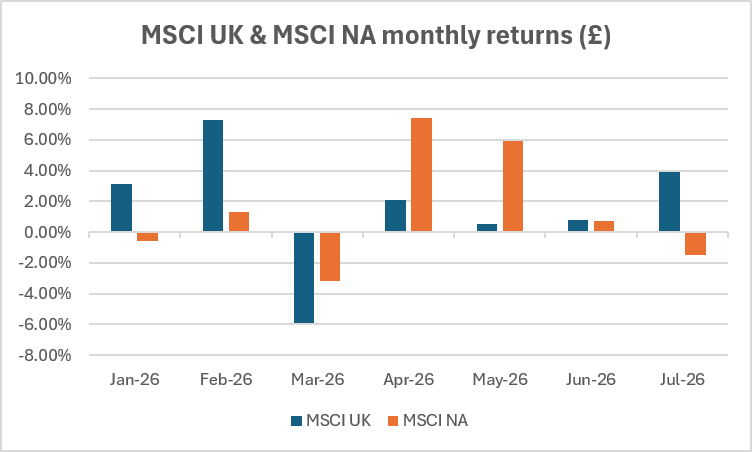
Source: LSEG Datastream, Quilter Cheviot Limited, 04/08/2026. Past performance is not a reliable indicator of future returns. The value of investments and the income from them can go down as well as up. You may not recover what you invest.
What this is not
Now this is not a piece trumpeting the UK stock market over others but merely a pointer to highlight how individual markets have different drivers. Crucially, the UK’s main stock market is viewed as having minimal exposure to the artificial intelligence (AI) trade, earning it the moniker the “anti-tech index”. This has made it attractive to those global investors looking to diversify away from volatile AI stocks. Think the violent share price swings (in both directions) being seen in semiconductor stocks in Asia and the US.
In place of tech, the outperforming (for now) UK benchmark is heavily weighted to financials and energy stocks. UK banks have benefited from the higher interest rate environment. With interest rates higher than they have been for some time, banks have been able to generate healthy interest rate spreads— the difference between the rate a bank earns on loans and the rate it pays on deposits. The Middle East conflict and resultant energy price shock has led to a higher-for-longer interest rate narrative taking hold —higher interest rates may be necessary to ward off any inflation threat. This has further boosted UK bank share prices this year. Meanwhile high energy prices have been tailwinds for the earnings of BP and Shell, both London heavyweights.
The US market too has its fair share of big banks and big oil but the dominance of tech in US indices means financials and energy stocks do not have as big a sway compared to the UK market.
The market narrative can of course switch back in favour of all things AI just as quickly as it has turned against the tech sector in recent weeks—tech and semiconductor stocks rebounded strongly towards the end of the week ended 31 July 2026. The outperformance of the UK’s stock market—MSCI UK ended July up 4%, while the US equivalent closed down 2%—has however shown its value especially when the AI-trade is in off mode.
What this is
What the above therefore serves to highlight is how diversified portfolios are better placed to manage risk and optimise returns, especially in times of economic uncertainty and market volatility.
Diversification is not just provided by investing in different geographic regions (the UK, Europe, US and Emerging Markets) but also via investing in different sectors, stocks and asset classes too. Asset class diversification can mean investing in equities, government or corporate bonds, alternatives (hedge funds, real estate/property and private equity). Sectors too can provide diversification. Different factors can cause different sectors (technology, energy, banks etc) to outperform or underperform over time. While the recent UK outperformance may appear to be based mainly on geographic diversification, it is seemingly more due to sector composition.
In terms of the investing spectrum, at the asset class level cash sits on the safer side but the promise of secure returns from holding cash does not come without risks. Over time, the purchasing power of cash can be eroded by inflation. Stocks on the other hand have historically provided higher returns, but these have come with higher volatility. It follows that a diversified portfolio is less susceptible to the swings of any one market, providing valuable stability during periods of economic uncertainty and so helping maintain a more consistent performance. Diversification also enables adjustments to be made to investments in response to changing market conditions, ensuring portfolios remain aligned with goals as the market landscape evolves.
Words and actions
By investing in a mix of geographies, sectors, stocks and asset classes, investors can reduce the impact of poor performance in any single investment. These are not just empty words. Just look at the price action of the UK and US stock markets over the past weeks and months. Words backed up by (price) action, now that sends a powerful message.
Quilter Cheviot Senator House
85 Queen Victoria Street London EC4V 4AB +44 (0)207 150 4000 enquiries@quiltercheviot.com quiltercheviot.com
This is a marketing communication.
Investors should remember that the value of investments, and the income from them, can go down as well as up and past performance and forecasts are no guarantee of future returns. You may not recover what you invest.
This document is not intended to constitute financial advice; investments referred to may not be suitable for all recipients. Any mention of a specific security should not be interpreted as a solicitation to buy or sell a security. This material is not tax, legal or accounting advice and should not be relied on for tax, legal or accounting purposes. Quilter Cheviot does not provide tax, legal or accounting advice. You should consult your own tax, legal and accounting adviser(s) before engaging in any transaction.
Quilter Cheviot and Quilter Cheviot Investment Management are trading names of Quilter Cheviot Limited, Quilter Cheviot International Limited and Quilter Cheviot Europe Limited. Quilter Cheviot International is a trading name of Quilter Cheviot International Limited.
Quilter Cheviot Limited is registered in England and Wales with number 01923571, registered office at Senator House, 85 Queen Victoria Street, London, EC4V 4AB. Quilter Cheviot Limited is a member of the London Stock Exchange, authorised and regulated by the UK Financial Conduct Authority and as an approved Financial Services Provider by the Financial Sector Conduct Authority in South Africa.
Quilter Cheviot International Limited is registered in Jersey with number 128676, registered office at 3rd Floor, Windward House, La Route de la Liberation, St Helier, JE1 1QJ, Jersey and is regulated by the Jersey Financial Services Commission and as an approved Financial Services Provider by the Financial Sector Conduct Authority in South Africa. Quilter Cheviot International Limited has established a branch in the Dubai International Financial Centre (DIFC) with number 2084, registered office at 4th Floor, Office 415, Index Tower, Al Mustaqbal Street, DIFC, PO Box 122180, Dubai, UAE which is regulated by the Dubai Financial Services Authority. Promotions of financial information made by Quilter Cheviot DIFC may be carried out on behalf of its group entities.
Quilter Cheviot Europe Limited is regulated by the Central Bank of Ireland, and is registered in Ireland with number 643307, registered office at Hambleden House, 19-26 Lower Pembroke Street, Dublin D02 WV96. This is a marketing communication.