
The page you were trying to view is not available for your role and region.
In a world seemingly dominated by all things artificial intelligence (AI), it is easy to overlook other areas of the market, particularly when tech-heavy equity benchmarks have been driven higher (and most recently lower) by a small band of very large tech stocks. And for good reason too. For, notwithstanding current volatility, those companies either positioned at the forefront of or embedded within the supply chain of the AI trade have been reporting forecast-busting earnings growth for much of the year. The same, however, could be said for other sectors too. None more so than banks. Below are 10 charts showing why, even after performing strongly in recent years, there are still reasons to be positive on the European banking sector.
Higher-for-longer rates
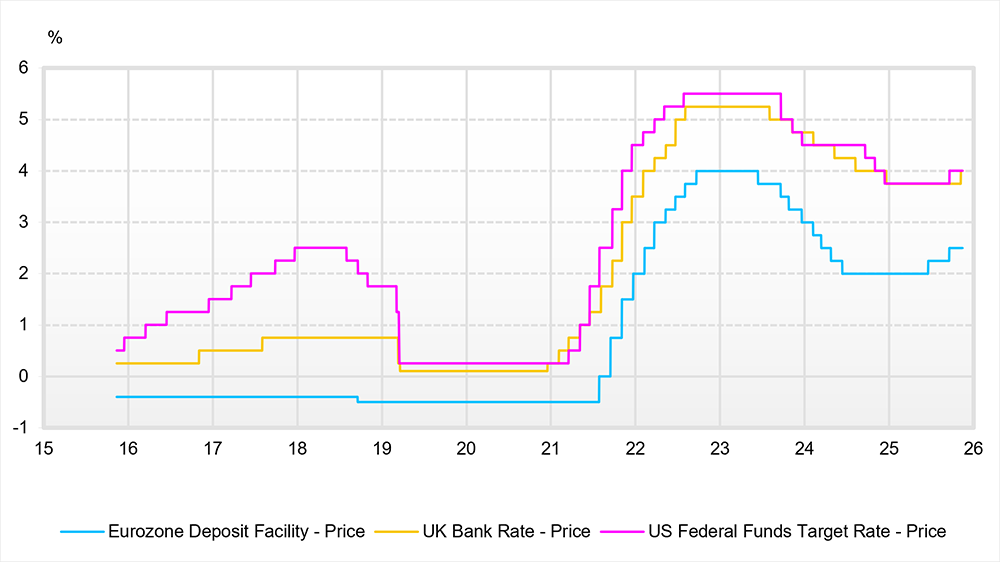
It may have gone somewhat under the radar, but the US, UK and European banking sectors have all beaten their respective broader stock markets over the past three years. It’s no coincidence that this outperformance and the timeframe it covers closely matches that of a structural shift that has taken place in the interest rate picture.
Chart#1: The changing interest rate picture
Source: Factset, Quilter Cheviot Limited, 12 November 2026. Past performance is not a reliable indicator of future returns. The value of investments and the income from them can go down as well as up. You may not get back what you invest.
Following the Global Financial Crisis (GFC), interest rates in all three jurisdictions were either at or close to zero. Remember ZIRP (Zero Interest Rate Policy)? Trouble is, in a low interest rate environment, banks struggle to make a decent margin on the rate they charge borrowers and the rate they pay out to depositors (the net interest margin).
The reopening of the global economy following the pandemic and the outbreak of war between Russia and Ukraine triggered an inflationary shock. This put paid to the era of ZIRP as central banks embarked on a rate-hiking cycle to bring soaring prices back under control. Maybe it was a case of recency bias (the tendency to attach more importance and value to recent experiences) that, even after rates had risen materially, market expectations remained anchored around the belief that interest rates would ultimately return to much lower levels.
The narrative has since changed. A series of developments, including trade tensions, geopolitical conflict, elevated government borrowing and the trillions of dollars being invested in AI infrastructure, have challenged the assumption that interest rates would return to the ultra-low levels that prevailed after the GFC. While policy rates differ across the US, UK and Europe, there is a growing acceptance that the post-GFC era may have been the exception rather than the norm.
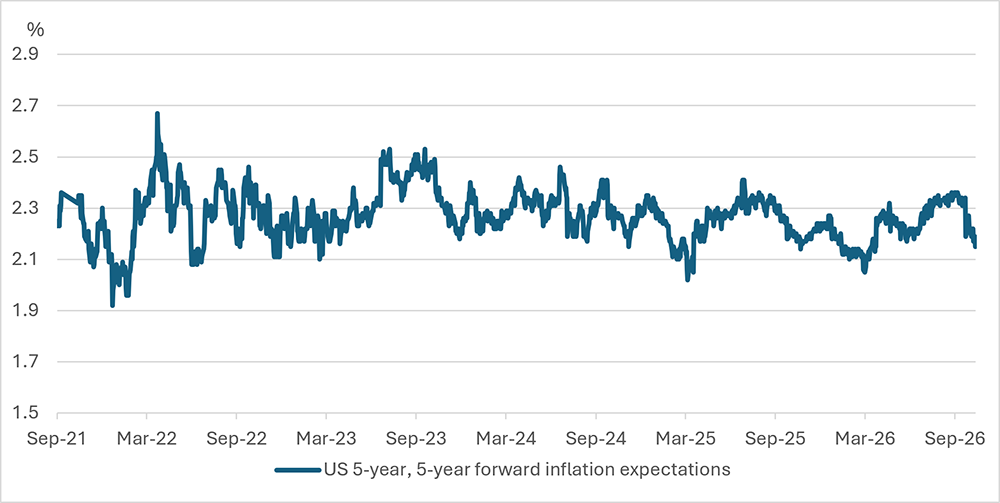
Chart#2: Inflation expectations remain relatively anchored
Source: FRED, Quilter Cheviot Limited, 12 November 2026. Past performance is not a reliable indicator of future returns. The value of investments and the income from them can go down as well as up. You may not get back what you invest.
Increasingly, zero rates, which squeeze bank margins, do not appear to be coming back any time soon.
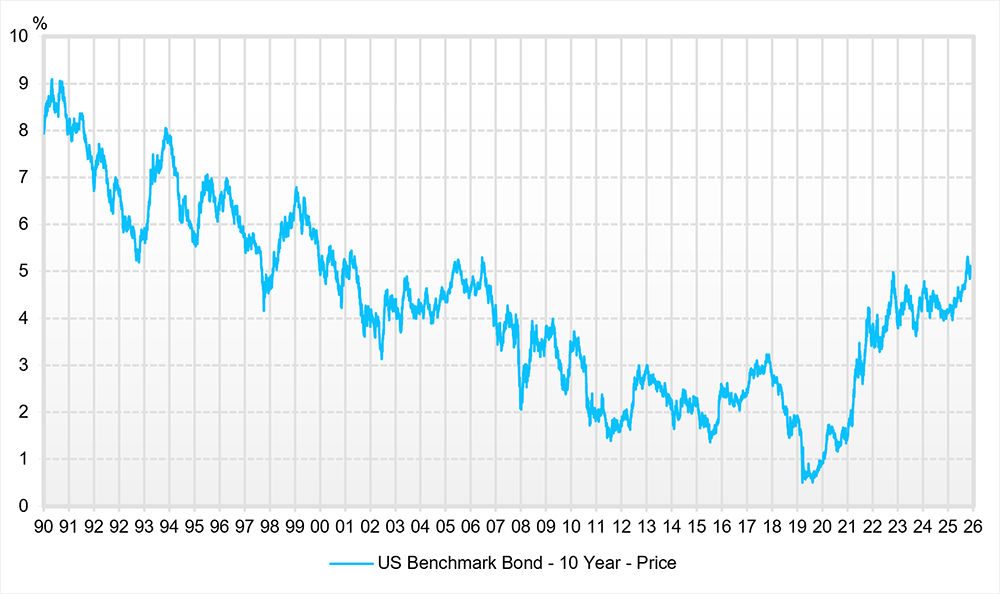
Government bond yields at 5%+
Importantly, inflation expectations remain relatively well anchored despite recent economic and geopolitical shocks. While interest rates will inevitably fluctuate over time, a return to the near-zero-rate environment that characterised much of the post-GFC period appears increasingly unlikely. For banks, that matters. A world of positive interest rates has supported wider net interest margins, stronger earnings generation and a marked improvement in profitability across the sector.
Chart#3: Sovereign bond yields may be at 20-year highs, but is this just a return to normal?
Source: Factset, Quilter Cheviot Limited, 12 November 2026. Past performance is not a reliable indicator of future returns. The value of investments and the income from them can go down as well as up. You may not get back what you invest
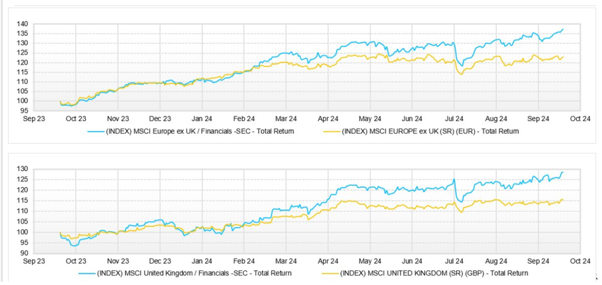
But what happens from here? If long-dated bond yields were to stabilise or retreat from current levels, this could prove supportive for financials. Rewind to October 2023, the last time the 10-year Treasury yield traded at the 5% level. Yields soon fell back quickly. And as they did so, European and UK financials stocks performed well, as the charts below show.
Chart#4: European and UK banks bounced post peak yields in October 2023 (indexed returns)
Source: Factset, Quilter Cheviot Limited, 12 November 2026. Figures in the top chart are denominated in EUR; returns may increase or decrease as a result of currency fluctuations. Past performance is not a reliable indicator of future returns. The value of investments and the income from them can go down as well as up. You may not get back what you invest.
Should elevated government bond yields stabilise at, or retreat from, current levels, this could provide a more supportive backdrop for financials.
Improved profitability
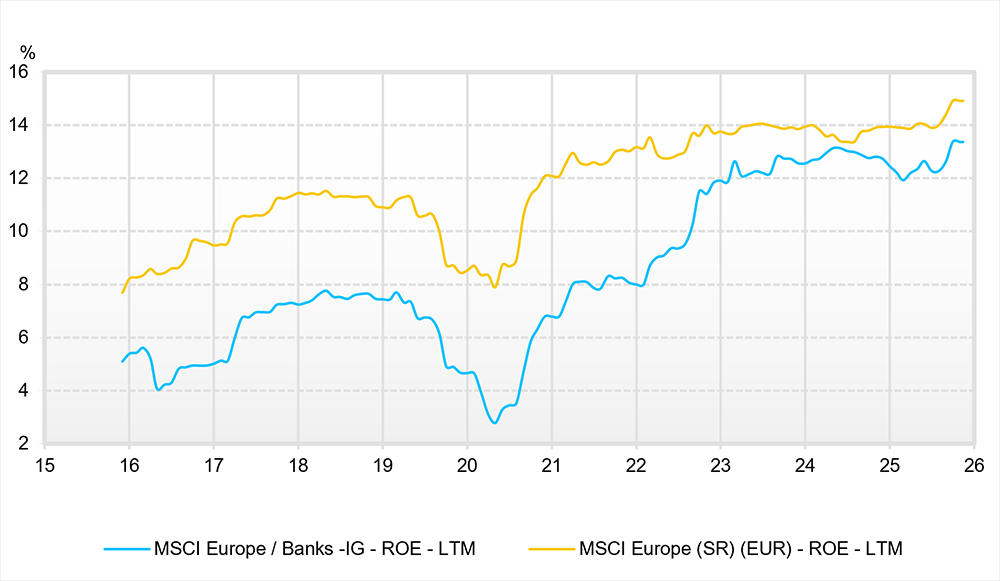
As mentioned earlier, higher rates mean higher net interest margins for banks, which ought to show up in higher profits. This is what we have seen.
Chart#5: European bank sector profitability has improved both absolutely and relatively
Source: Factset, Quilter Cheviot Limited, 12 November 2026. Past performance is not a reliable indicator of future returns. The value of investments and the income from them can go down as well as up. You may not get back what you invest.
And the chart below highlights how in recent years profitability at European banks, as measured by return on equity, has closed the gap with the wider market.
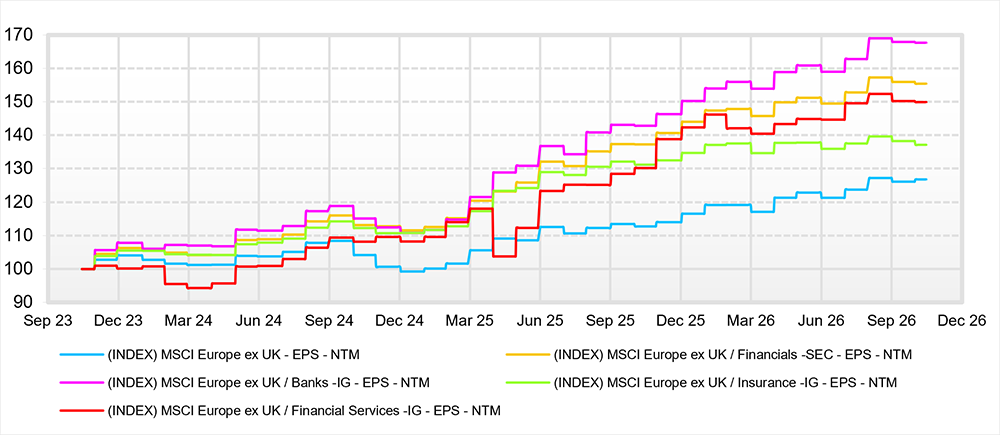
Chart#6: One-year forward EPS growth has driven European banks’ outperformance (indexed returns)
Source: Factset, Quilter Cheviot Limited, 12 November 2026. Past performance is not a reliable indicator of future returns. The value of investments and the income from them can go down as well as up. You may not get back what you invest.
European banks have delivered very strong earnings per share (EPS) growth, outstripping both the financials sector as a whole and the wider market.
Valuations
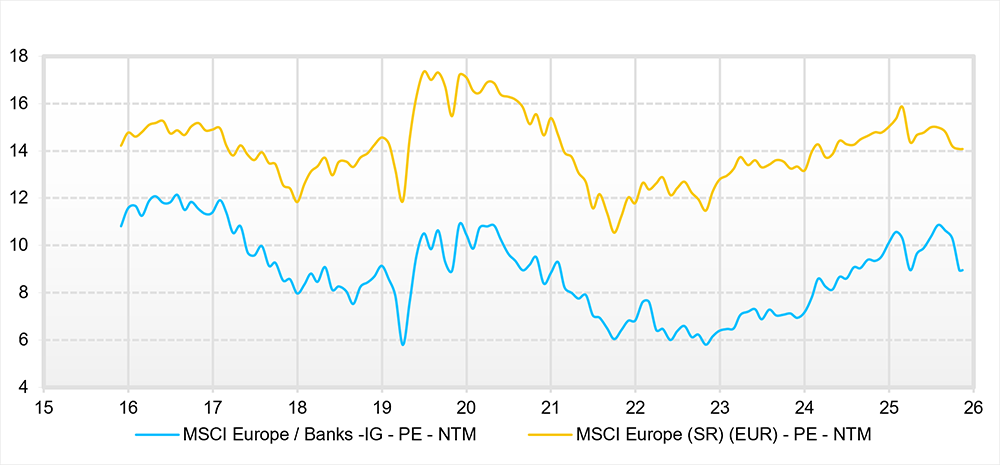
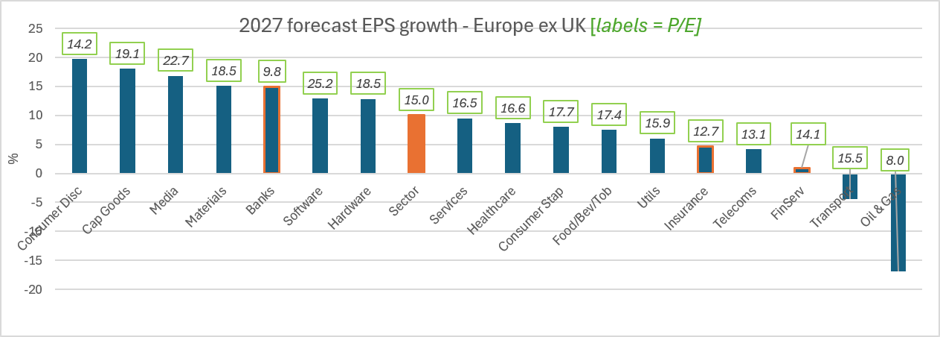
Despite this strong earnings performance, European banks trade on around 9 times forecast earnings, with EPS expected to grow by approximately 15%. This compares with around 14 times earnings and 10% EPS growth for the wider MSCI Europe ex UK.
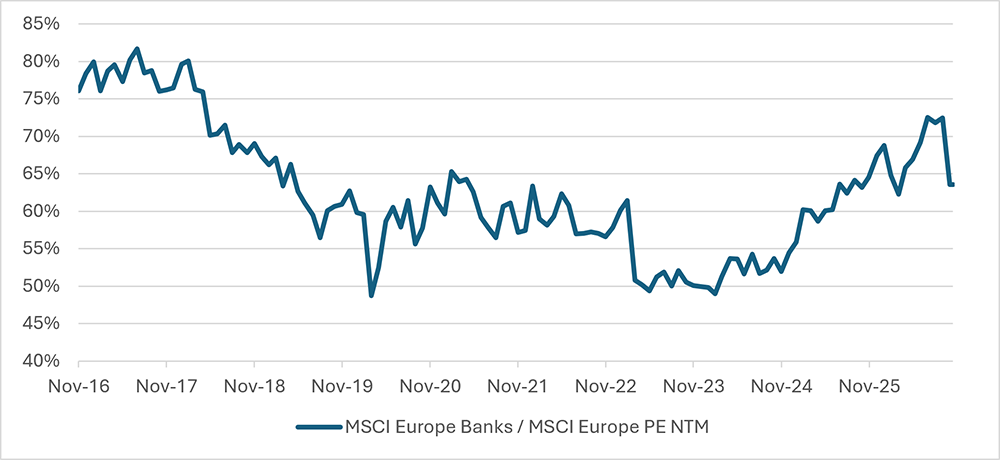
Chart#7: Valuations are still discounted at both absolute and relative levels
Source: Factset, Quilter Cheviot Limited, 12 November 2026. Past performance is not a reliable indicator of future returns. The value of investments and the income from them can go down as well as up. You may not get back what you invest.
But as the chart below demonstrates, earnings in the European banking sector are expected to continue to grow ahead of the wider market in 2027.
Chart#8: EPS growth remains decent for European banks
Source: Factset, Quilter Cheviot Limited, 12 November 2026. Past performance is not a reliable indicator of future returns. The value of investments and the income from them can go down as well as up. You may not get back what you invest.
European banks have re-rated from 6x earnings in 2019 to 9x today, but they continue to trade at a discount to the market.
Distributions
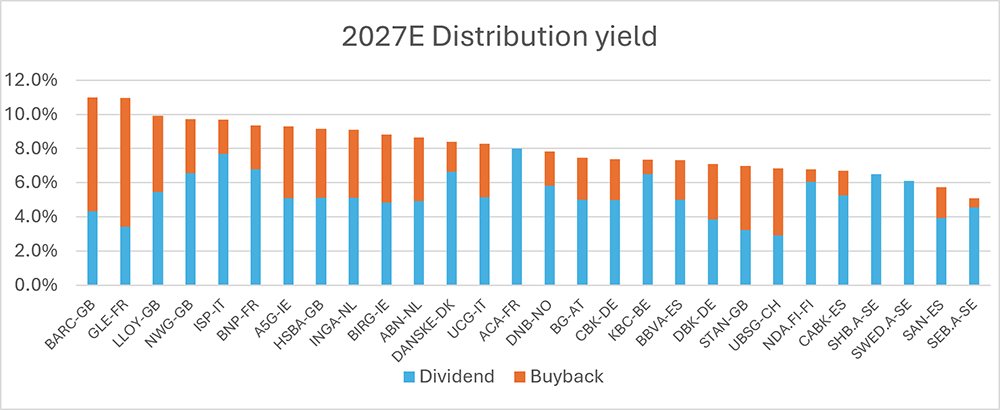
One of the attractions of the banking sector in recent years has been the combination of strong capital generation and attractive shareholder distributions through dividends and buybacks. This remains the case today, with some banks offering prospective distribution yields of around 10% or more (note that prospective yields and distributions are not guaranteed). French banks feature prominently among these names, although concerns over France's fiscal position, political uncertainty and rising government bond yields have weighed on share prices, contributing to their particularly attractive distribution yields.
Chart#9: Banks are trading on distribution yields of 10% or more
Source: Factset, Quilter Cheviot Limited, 12 November 2026. Past performance is not a reliable indicator of future returns. The value of investments and the income from them can go down as well as up. You may not get back what you invest.
The banking sector continues to offer some of the highest distribution yields in the market.
A growing Eurozone?
Whisper it, but there are signs that growth in Europe is picking up. Manufacturing and services PMIs (Purchasing Managers' Indexes), monthly indicators of economic activity, show that despite the Middle East conflict and energy price shock, core Europe is exhibiting strong positive momentum, especially Germany. Even services PMIs, which have generally been weaker in line with consumer sentiment, have been showing signs of improvement.
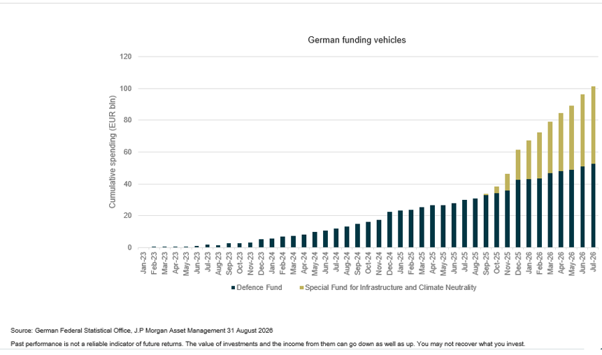
One reason put forward to explain the strong German PMIs is that the near-trillion-euro government investment drive to update and improve the country’s infrastructure and defence capabilities is starting to show through. And it’s not just Germany spending on defence. Other countries are doing the same.
Chart#10: German stimulus is ramping up, but the full impact is yet to be felt
Source: German Statistical Office, JPMorgan Asset Management 31 August 2026. Past performance is not a reliable indicator of future returns. The value of investments and the income from them can go down as well as up. You may not get back what you invest.
The step-up in spending promises to be a multi-year growth driver. Owing to the central role they play in any economy, banks are well placed to benefit.
Reasons to be wary too
Being central to the functioning of an economy works both ways. A faltering economy could lead to an uptick in loan losses for example, although currently there are no real concerns around the asset cycle. Connected to this are those rising bond yields, particularly in certain parts of Europe. Should yields keep rising then there is the potential for these to have knock-on effects for equities. And owing to its status as an energy importer, Europe is heavily exposed to the Middle East conflict.
For now, the outlook for the European economy is balanced with tailwinds from government stimulus on the one hand and headwinds such as the energy price shock on the other.
Uniquely placed?
Rising yields and a potential economic slowdown remain risks for the European banking sector, but the same is true for the AI trade and the wider market. And the AI trade has its own risks to navigate too. Witness the share price weakness seen among leading AI names in recent weeks and the wide range of reasons that lie behind this: the Democrat clean sweep of both houses of Congress in the US—seen as a potential brake on data centre roll-out; calls for greater regulation— not just from the Democrats but also the industry itself; and the threat of the cannibalisation of existing revenue streams—Alphabet’s latest results hinted that this may already be happening.
European banks meanwhile have enjoyed a powerful tailwind from the move away from ultra-low interest rates. And while risks remain, including a weaker economy, higher loan losses and further rises in government bond yields, the sector enters this period from a position of strength. Profitability has improved, capital levels remain robust, shareholder distributions are attractive and valuations continue to compare favourably with the wider market.
Importantly, banks are among the clearest beneficiaries if interest rates remain structurally higher than they were in the decade following the GFC. For investors then, the sector offers earnings power, capital returns and valuation support. That’s a combination that remains difficult to find elsewhere in the market.