Search

Banking on the Eurozone economy (and beyond)

Date: 06 March 2026

7 minute read

Rewind to the beginning of the year and Europe looked set fair to build on the progress made in 2025. It had weathered the tariff storm well, so much so the Eurozone is estimated to have grown 1.5% in 2025, according to the European Commission (+1.2% had previously been pencilled in).

The 2025 upgrade was no one-off either. In December, the European Central Bank (ECB) upped its 2026 growth forecasts for the Eurozone economy to 1.2% from 1%. And the bloc was (and continues to be) set to enjoy a huge fiscal boost in the years ahead courtesy of a ramp-up in defence and infrastructure spending. There was good news on the inflation front too with prices firmly back under control after spiking higher in 2022 following the Russian invasion of Ukraine and tracking comfortably lower than US and UK equivalents for the foreseeable future. What was not to like?

Now, if there are lessons to be learned from the last few years then ‘never take anything for granted’ and ‘expect the unexpected’ would surely feature high in the rankings— think the Covid-19 pandemic, the Russian / Ukrainian conflict, US trade tariffs, etc. Cue the launch of the US and Israeli joint attack on Iran on 28 February. With the conflict just days old, the devastating human loss and destruction are sadly there for all to see. Not so the impact on the global economy. Here the length and severity of the conflict will be key. It goes without saying, the sooner hostilities come to an end, the sooner global economic activity returns to normal. And if it does, one sector in particular is well-placed to benefit more than most from the positive narrative surrounding the Eurozone economy due to the central role it plays in any economy—banks.
Positive tailwinds

To be fair, European banks have already been prospering. For while interest rates in Europe are relatively low compared to the US and UK, they are firmly positive now after a decade or so of near-zero/negative rates. So, with interest rates higher than they have been for some time, banks have been able to generate healthy interest rate spreads— the difference between the rate a bank earns on loans and the rate it pays on deposits.

Interest rates have not been the only tailwind behind European banks. Strong equity markets— the MSCI Europe ex UK index was up 20.4% in 2025 compared to a 4.5% return from US stocks in 2025 (in euros)— have helped fuel a recovery in fees generated from investment banking activities. The step-up in fiscal stimulus, most notably in Germany with its huge defence and infrastructure package, promises to be a multi-year growth driver for the region. Add to this, an ongoing focus on cost discipline which has seen banks across Europe streamline their operations, reduce expenses and create efficiencies and you have the ingredients for a step-up in banks’ profitability. This is what we have been seeing.


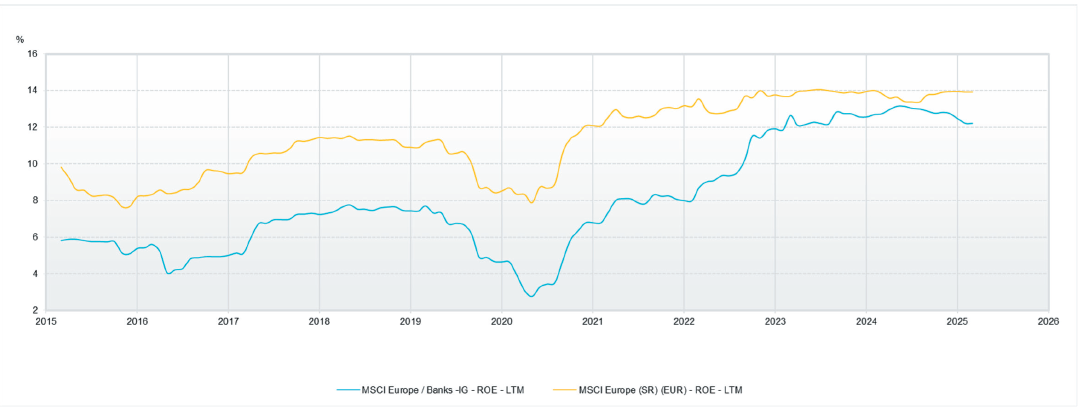
European bank profitability improved - absolute and relative

European bank profitability graph

Source: FactSet, Quilter Cheviot Limited 06/03/26. Past performance is not a reliable indicator of future results. The value of investments and the income from them can go down as well as up. You may not get back what you invest.

Healthy net interest margins, strong fees and good cost discipline mean banks profitability has improved
markedly (absolute and relative to the market), particularly as loan losses remain well controlled.

And what have banks been doing with all that capital they have been generating? They’ve been returning it to shareholders. Currently, the sector offers a total distribution yield of ~8% (dividend yield of ~5%, buyback yield of ~3%).

Not gone unnoticed

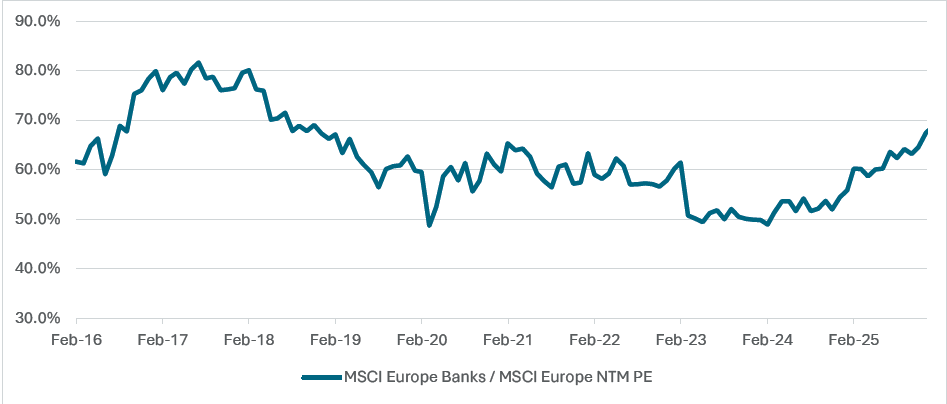
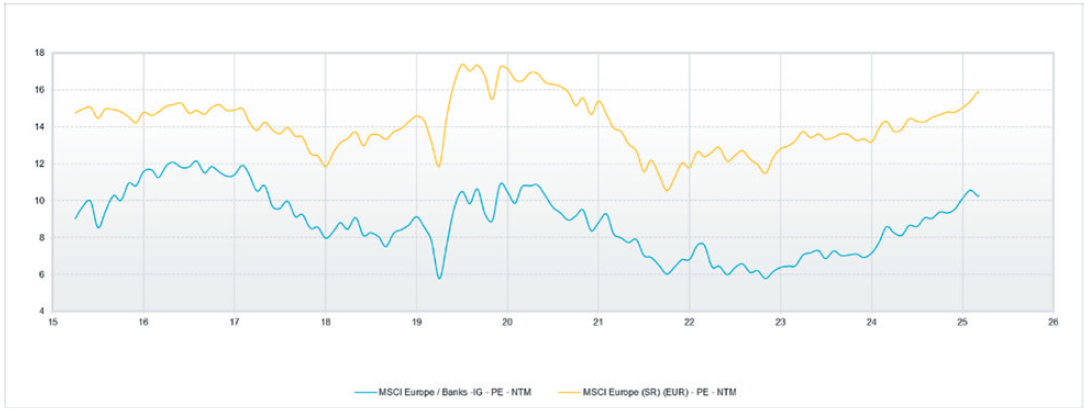
The improved return profile has not gone under the radar. European banks had a very strong 2025 with MSCI Europe ex UK banks up +84% versus MSCI Europe’s +20%, marking another year of outperformance following the nadir of the Covid pandemic (September 2020). The word nadir is key— for it was a big nadir. So much so, that even after such a strong run, bank share prices still trade at discounts to historic valuations both on an absolute and relative basis.

MSCI Europe ex UK banks trade on a 12-month forward price-earnings (PE) multiple of 10.3x which compares with the MSCI Europe trading on 15.9x, a 35% discount. European banks have re-rated to trade above their 10-year average (8.9x and 38% discount) but recent history has been distorted by the fact that for much of this time, they were having to cope with near zero or even negative interest rates which weighed on net interest margins.

Valuations are still discounted (absolute)

Valuations are still discounted (absolute) graph

Source: FactSet, Quilter Cheviot Limited 06/03/26. Past performance is not a reliable indicator of future results. The value of investments and the income from them can go down as well as up. You may not get back what you invest.

Valuations are still discounted (relative)
Valuations are still discounted (relative) graph


Source: FactSet, Quilter Cheviot Limited 06/03/26. Past performance is not a reliable indicator of future results. The value of investments and the income from them can go down as well as up. You may not get back what you invest.

The year of the ‘e’?

After such a strong run the valuation case behind European banks is not as powerful as it once was, so it is likely the re-rating seen across the sector has largely run its course. But that does not mean the sector cannot move forward from here. For if 2025 was the year when the ‘p’ in the Price / Earnings ratio stole the show, 2026 could well be the year of the ‘e’, specifically earnings growth.

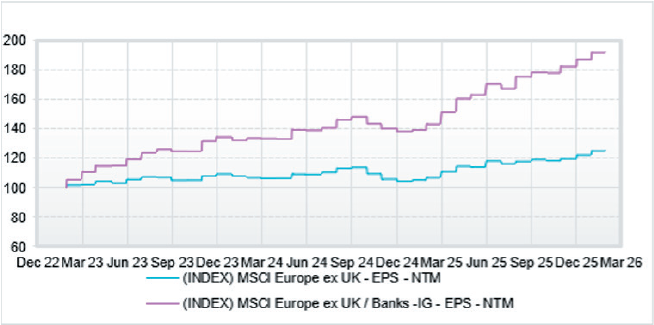
And earnings growth is very much alive and well across the sector and has been rising faster than the market as a whole.

European banks earning growth
European banks earning growth graph

Source: FactSet, Quilter Cheviot Limited 27/02/26. Past performance is not a reliable indicator of future results.
The value of investments and the income from them can go down as well as up. You may not get back what you invest.

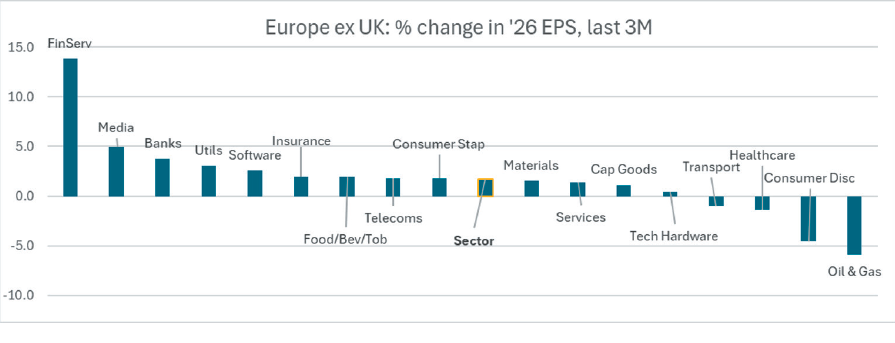
Furthermore, as the chart below shows, earnings forecasts at European banks have continued to be revised higher.

European banks earning revisions – among the highest across the market

European banks earning revisions – among the highest across the market graph

Source: FactSet, Quilter Cheviot Limited 27/02/26. Past performance is not a reliable indicator of future results.
The value of investments and the income from them can go down as well as up. You may not get back what you invest.


Positive earnings growth without further movement in price, could see European banks trading on meaningful valuation discounts once more.

Earnings growth looks set to take over from valuation as a key driver of the sector.

What about the AIelephant in the room?

Banks’ earnings and returns could well be boosted by artificial intelligence (AI) too. If you were to rank the major themes that were pre-occupying markets pre-conflict, then AI would rank highly, specifically which companies and sectors will benefit from the technology and which will lose out. European banks stand to be among the beneficiaries with several major names already predicting that AI will enable them to do more with less.

For example, Banco Santander’s One Transformation strategy, which incorporates AI, is targeting an increase in fees generated per active user to €135 by 2028 from €130 in 2025 as well as a reduction in costs per active user to €220 from €264 over the same time frame. AI is set to play its part in the bank’s 2028 targets of mid-single digit revenue growth, lower costs and a Return on Tangible Equity (RoTE) of over 20%.

Banks are potential AI-beneficiaries which would bode well for future earnings.

A heterogenous sector

The performance charts above are for the European banking sector as a whole. A deeper dive into the sector itself reveals a non-homogenous membership that is comprised of banks executing a range of business models and strategies and having diverse geographic exposures.

There are banks focused solely on their domestic markets—Allied Irish Bank, for example, is a direct play on the robust Irish economy; and there are those with a more regional tilt such as Nordea, the leading bank in the Nordics that serves around 11m retail and corporate customers and is prized for its strong capital ratios and consistent profitability. And then there are more internationally diversified names such as Spain-based Banco Santander which, as well as offering a full suite of financial services, has significant exposure to growth markets in Latin America; and Dutchbased ING which serves around 40m customers across its operations in 38 countries.

With banks focused on domestic, regional and global markets to choose from, the European banking sector is more than just a play on the Eurozone. And that’s not necessarily a bad thing. For even though banks have been beneficiaries of a supportive macroeconomic backdrop, favourable interest rate environment, rising profitability and earnings, and historically undemanding valuations, it often pays not to take things for granted.

The value of your investments and the income from them can fall and you may not recover what you invested.