Search

Are we entering an era of European exceptionalism?

Date: 19 February 2026

3 minute read

Three charts looking at European vs US stocks

European stocks have outperformed peers thus far in 2026, lifted by improving economic data, fairer valuations and relative political stability. The moves extend a trend which began last year, and the current fundamental environment suggests that the relative attraction of European equities could well become a multi-year theme.

Chart 1: European stocks have strongly outperformed US stocks since the start of 2025

Chart showing that European stocks have strongly outperformed US stocks since the start of 2025

Source: LSEG Datastream, Quilter Cheviot Limited 17/02/2026

Recent economic data for the Eurozone has come in better than expected partly due to the bloc not suffering as adverse reaction to higher US trade tariffs as many had feared. 2025 GDP growth is estimated to be 1.5%, according to the European Commission, and the European Central Bank (ECB) has upgraded its future growth projections. Inflation is firmly back under control after spiking higher in 2022 following the Russian invasion of Ukraine and is expected to track comfortably lower than US and UK equivalents for the foreseeable future.

Chart 2: European stocks bucked the trend of US outperformance last year, rising 20.4% compared to a 4.5% return from US stocks
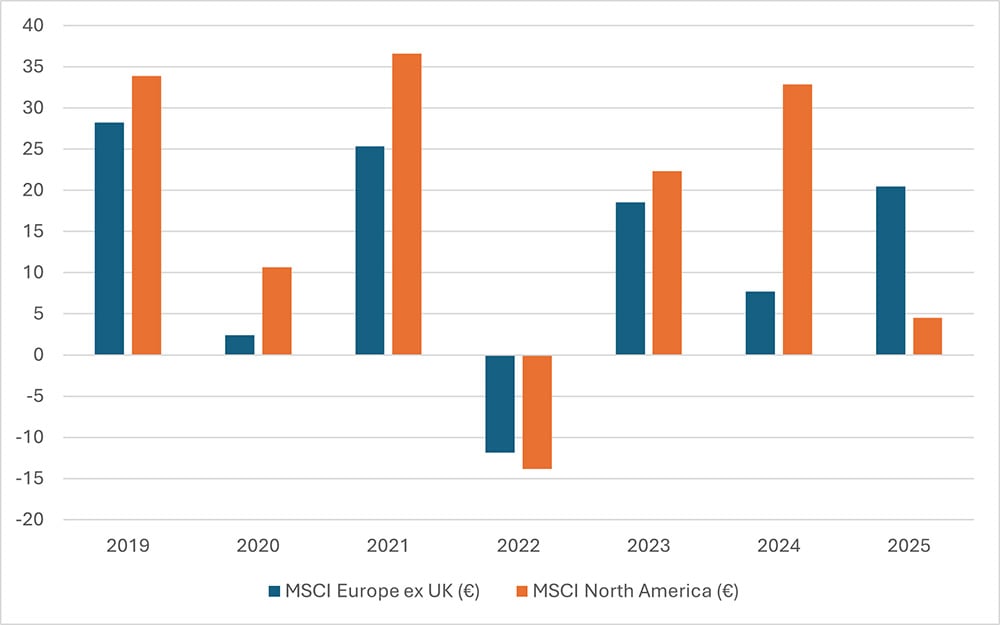
Chart showing that European stocks bucked the trend of US outperformance last year, rising 20.4% compared to a 4.5% return from US stocks

Source: LSEG Datastream, Quilter Cheviot Limited 17/02/2026

The strong relative performance of European stocks since the start of 2025 marks a notable change from the preceding years when US exceptionalism was very much in vogue. The rise of US big tech stocks — in particular the Mag 7 (Alphabet (Google), Amazon, Apple, Meta, Microsoft, Nvidia and Tesla) — led to a number of years of strong US outperformance with many investors starting to believe that these stocks were the only game in town. After the 2022 drawdown, the launch of ChatGPT sparked a growing hype around the possibilities of AI (Artificial Intelligence) causing a wave of investor enthusiasm which seemingly culminated with the large 2024 outperformance (US stocks returned 33% vs 8% for European stocks).

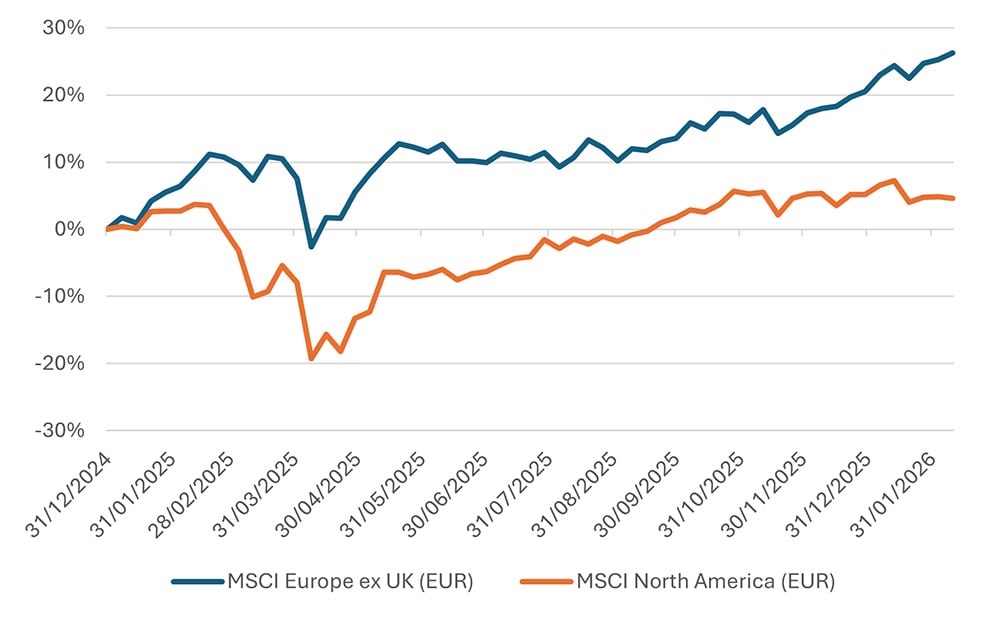
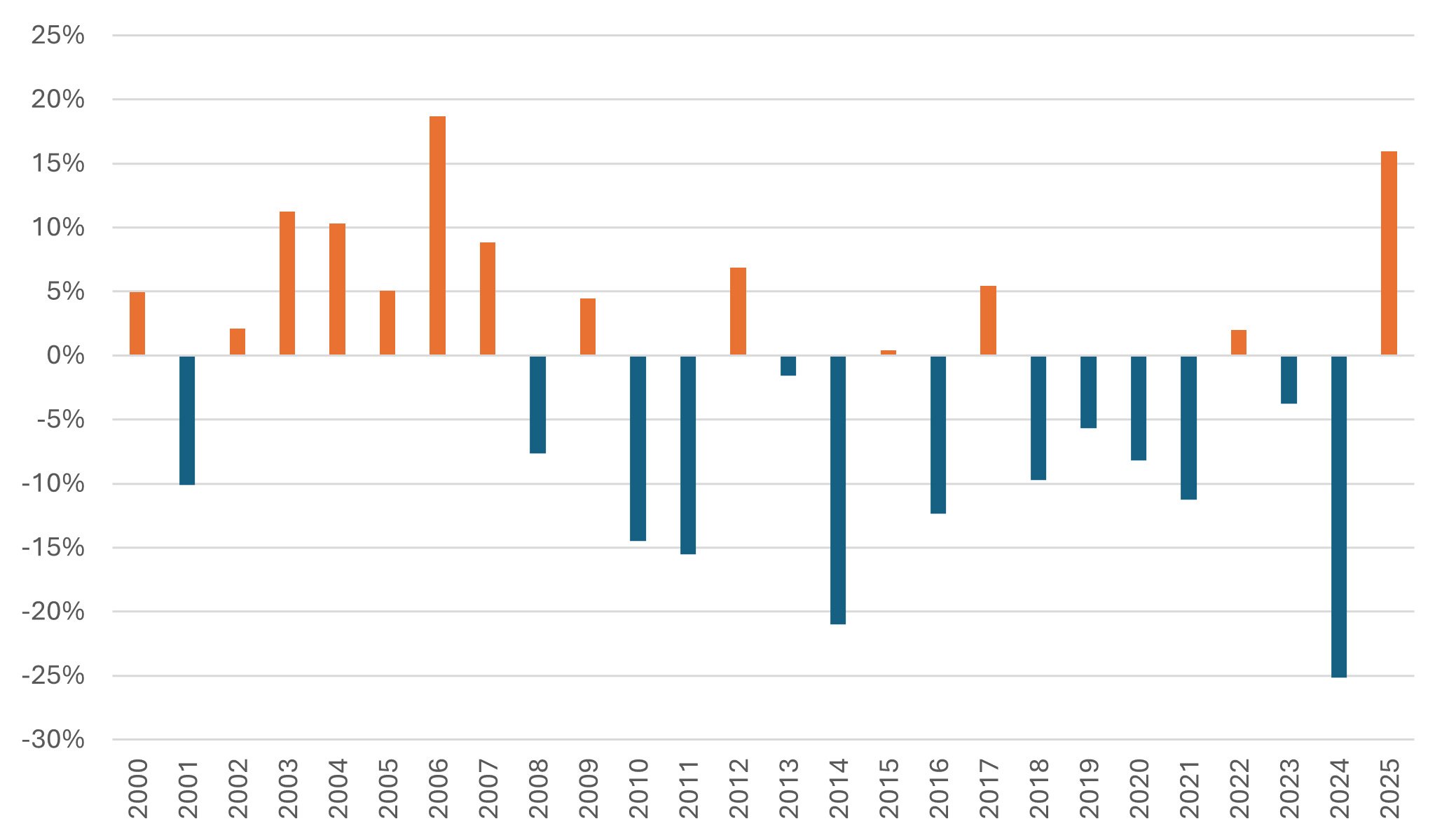
Chart 3: MSCI Europe ex UK - North America, total return in EUR. A positive reading indicates the outperformance of European stocks while a negative reading denotes US stock outperformance

Chart showing MSCI Europe ex UK - North America, total return in EUR

Source: LSEG Datastream, Quilter Cheviot Limited 17/02/2026

Although US stocks have outperformed European stocks over the last seven years, a longer-term view paints a different picture. Going back to the turn of the millennium, European stocks have in fact outperformed US stocks in 13 of the 26 years — 50% of the time.

Conclusion

Looking back at the past performance of European and US stocks, it is apparent that over the long term there have been sustained periods of outperformance for both regions. European stocks delivered higher returns during the 2000s as the fallout from the US dotcom bubble bursting weighed on US markets. The Eurozone sovereign debt crisis saw some years of large US outperformance starting in 2010. The past 10 years have seen US tech companies post incredible growth and earnings figures, leading to a prolonged period of relative US outperformance. However, the last year or so has seen European stocks outperform once more, with 2025 seeing the largest relative outperformance since 2006!

The lesson here is that US stocks are not inherently better investments than European stocks and that fundamentals really do matter. The fundamental investing backdrop in the early- to mid-2000s was more supportive of European stocks, whereas a decade later it was clearly more favourable for the US. Recent economic and geopolitical events, along with market valuations, suggest that the pendulum may be swinging back in favour of Europe. That said it is important to monitor the situation closely as it can be dynamic and change quickly, which is why at Quilter Cheviot we have one of the largest in-house research teams in the discretionary industry, consisting of 22 equity, fixed interest and collective (fund) analysts that produce in excess of 37,000 research hours per year!

Author

Alan McIntosh

Chief Investment Officer of Quilter Cheviot Europe

The value of your investments and the income from them can fall and you may not recover what you invested.