
Search

Perseverance pays - the case for staying invested

Date: 06 March 2026

5 minute read

Time in the market beats timing the market

This well-known maxim encapsulates arguably the most important piece of investment advice – to stay invested - and is particularly timely given the current environment and recent drops in both equities and bonds. Evidence shows that remaining invested for the long term can be one of the best things you can do for your overall wealth.

The start of 2026 has seen market volatility increase, first with concerns around the disruptive impact of AI and more recently the conflict in the Middle East. While acknowledging the profound humanitarian tragedy that any war represents, it is our job as investment managers to examine the effects of any geopolitical events on global financial markets.

Compared to last year’s 12-day war this conflict appears to be broader-based and is expected to have wider reaching implications. Having said that, the reality is most geopolitical events do not have a long-lasting impact on markets, due to long-term returns primarily being driven by economic growth and/or inflation, rather than changes in investor sentiment.

Investors should maintain a long-term horizon and look through short-term headwinds. Staying invested could allow you to benefit from the growth in businesses and the economy over time, and while it can be tempting to take money out of the market in the short term, history shows it is highly likely to deliver lower returns overall.

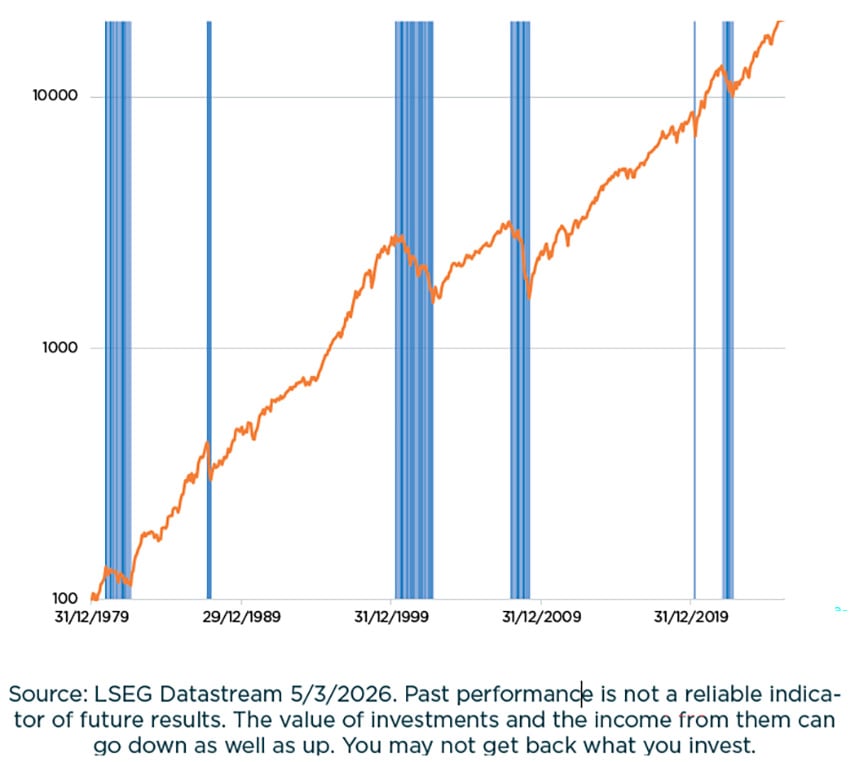
Markets trend up over time, despite several bear marketsMarkets trend up over time, despite several bear markets
Our first chart shows the performance of US shares from the end of December 1979 to March 2026. Overall, the picture is encouraging with investors enjoying positive returns during the period, despite several significant declines along the way - the market experienced several bear markets, defined as a market decline of 20% or more. Downturns are not rare events and typical investors, in all markets, will experience many bear markets during their lifetime.

The average peak to trough decline lasted 13 months, while on average it took 19 months to subsequently recover from a trough to the previous peak.

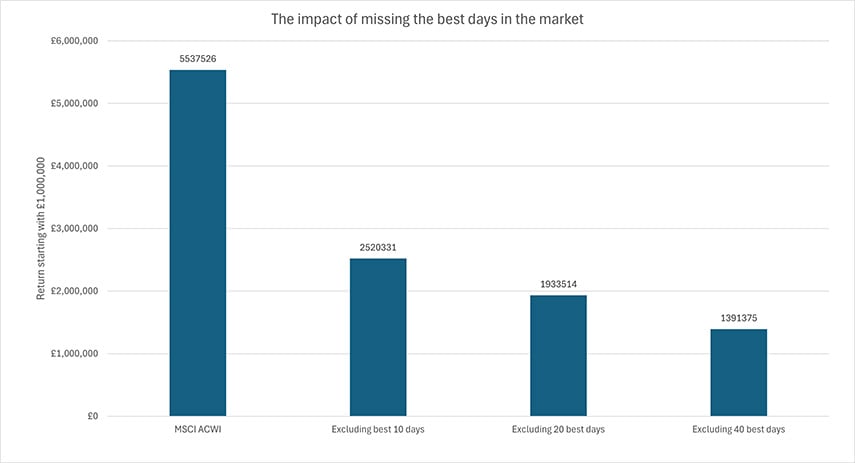
The impact of missing the best days in the market

Source: LSEG Datastream 5/3/2026. Past performance is not a reliable indicator of future results.
The value of investments and the income from them can go down as well as up. You may not get back what you invest.

This demonstrates the negative impact of missing the best days in the market. While it might seem preferable to avoid bear markets, many of the largest daily gains occur during these periods. Missing these days by divesting into cash could have a clear and significant detrimental impact on your overall returns.

The bar on the left-hand side shows how much a £1m portfolio invested in global shares (reinvesting dividends – see chart below) at the start of the year 2000 would be worth now. The bars to the right show how much your portfolio would be worth had you missed the best 10, 20 and 40 days in the market.

The dividend difference

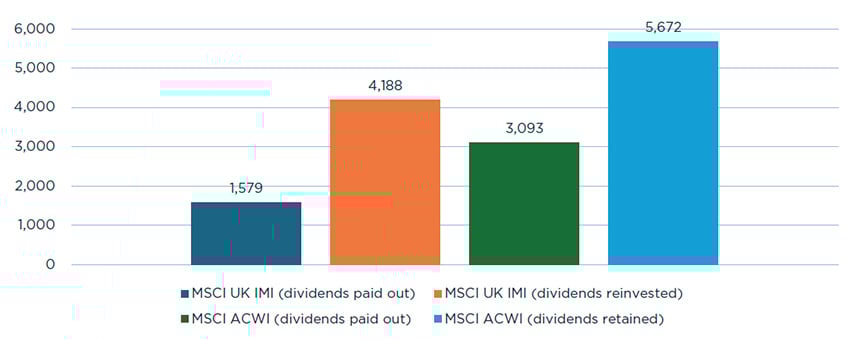
Dividends are payments made by companies to shareholders and can account for an extremely significant portion of longterm returns. Reinvesting these dividends allows them to compound and could provide a major increase to overall returns. For instance, reinvesting dividends could more than double the overall return, as has been the case for UK indices since the turn of the millennium. The following chart shows the performance of £1,000 invested into UK shares and US$1,000 invested into global shares, with dividends reinvested or paid out from the end of December 1999 to March 2026.

Reinvesting dividends can make a significant difference to overall returns

Reinvesting dividends can make a significant difference to overall returns

Source: LSEG Datastream 5/3/2026. Past performance is not a reliable indicator of future results.
The value of investments and the income from them can go down as well as up. You may not get back what you invest.

Critically, dividends are often paid at regular intervals and therefore if you try to time your entry in and out of markets, you may miss these payments (there can also be minimum holding periods to receive dividends). Missing dividend payments would have severely diminished your investment returns over the past 25 years – for the UK you would have received the returns in dark blue rather than orange and for global equities you would have received the returns in green rather than light blue.

Conclusion

In conclusion, there have been clear benefits to remaining invested over the past 40 years. Historical results should not be seen as a guarantee of future performance, but the rationale behind this approach is sound. Looking through short-term volatility and maintaining a long-term focus has proven to be a winning strategy, largely due to not missing the best days in the market and the reinvestment of dividends.

Would you like to speak to one of our experts?

You can contact us by phone, email or simply complete the online form and our team will be in touch with you soon.

Contact us

What we offer

Our investment solutions are designed to give your money the best opportunity to grow. Make the right investment choices for you and your loved ones with our Investment Management services.

What we offer

The value of your investments and the income from them can fall and you may not recover what you invested.